

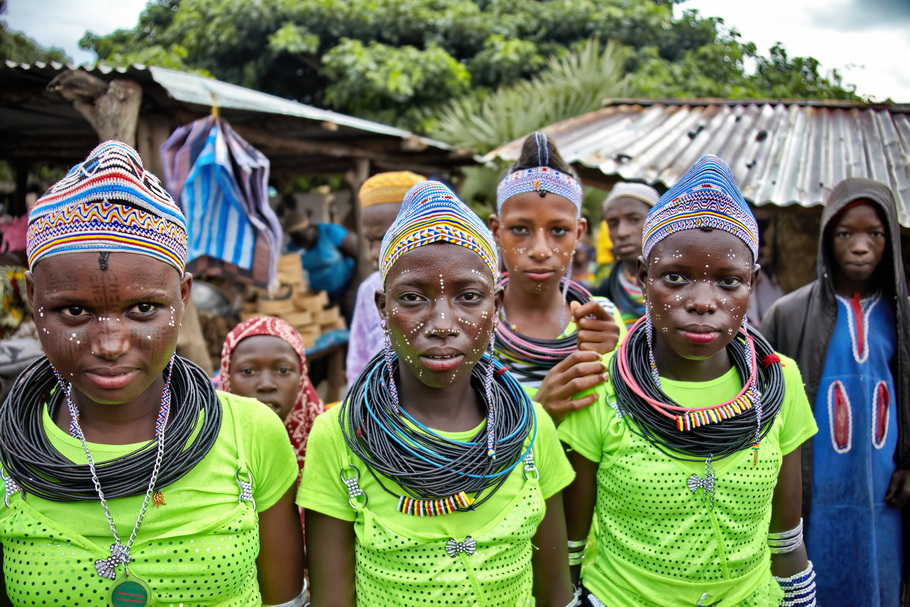
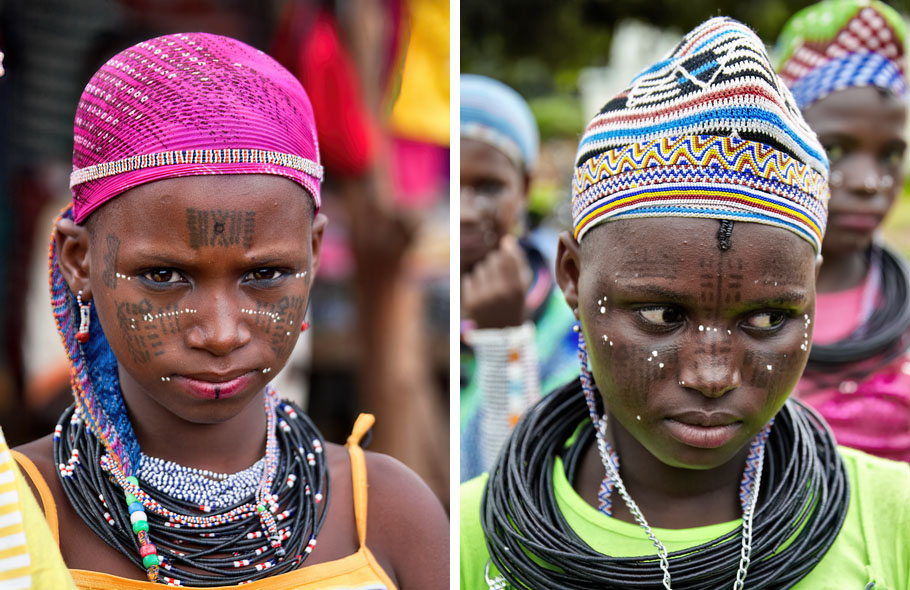
The Fulani of Borgu are part of the region’s pastoral and Muslim population, arriving in different waves. They live between Togo, Nigeria and Benin, with a strong presence in Benin’s Borgou Department and Nigeria’s Niger State. While they integrated in part with local society, they maintain their Fulani identity and act as a bridge between the pastoral world and the farming communities of Borgu.
In Borgu (the historical region split between Benin and Nigeria), the Fulani are present, but not as an original group — they mostly arrived later, through pastoral expansion and Islamic influence.

The term Borgu does not refer to a Fulani subgroup, but rather to a historical and cultural region of West Africa, with its own ethnic and political identity. Borgu is not an ethnic group in itself.
The original inhabitants of Borgu are the Bariba (Baatonu), an ethnic group distinct from the Fulani.They speak Baatonum, a Gur language. They have a strong equestrian and military tradition; in the history of Benin and Nigeria, they are remembered as warriors and horsemen
There are over twenty ethnic groups with a significant representation in present day Borgu. The following chart lists these groups according to their language classification and gives approximate population figures for each language: total population, population in Nigeria, population in Benin and population in Borgu as a whole. The population figures are derived from the Nigerian census of 1991, the Benin census of 1992 (Bureau Central du Recensement) and the 'Ethnologue' edited by Grimes (1992).
The Fulbe constitute over 25% of the Borgu population. They call themselves Fulbe (Pl.) and Pullo (Sg.), but are commonly known as Fulani in English and Peul in French. They call their language Fulfulde. It is also called Fula. They are regarded as socially inferior throughout Borgu, except in the Kaoje area. They have their own chiefs, but are generally despised by the other ethnic groups.
They were not generally allowed to hold political office and were treated more or less as slaves by the Borgu rulers. They are settled in villages or encampments throughout Borgu, usually associated with Baatombu and Boko towns and villages to whom they sell milk and cheese and look after their cows.
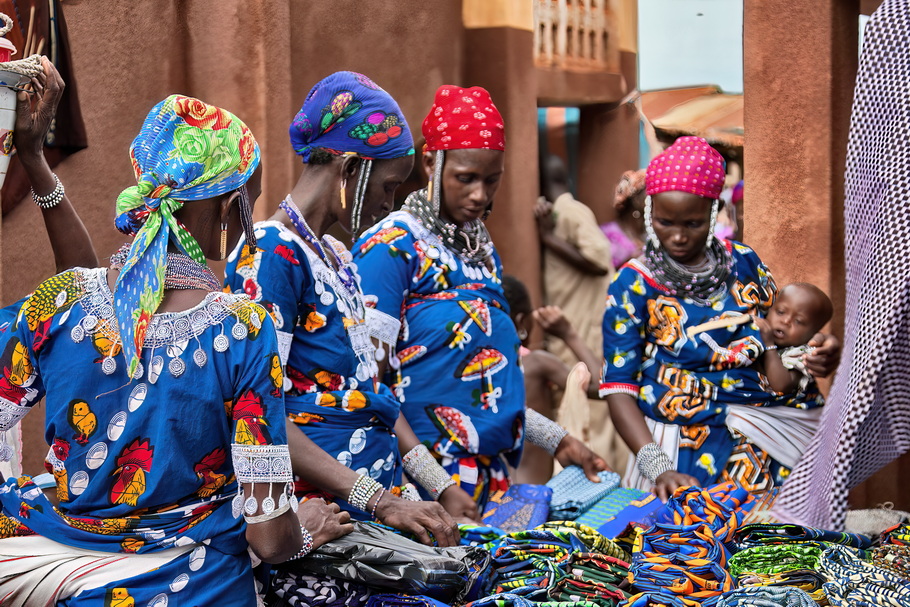
They buy implements from Baatombu and Boko blacksmiths and grain if needed and trade at their markets.Borgu Fulbe are sedentary and cultivate crops as well as raising cattle. The Fulbe have had political power at Kaoje since the colonial government gave it to Sokoto in 1907.
Many Fulani in Borgu are Mbororo (nomadic or semi-nomadic herders), dedicated to cattle transhumance, moving seasonally in search of pasture.
Other Fulani groups in Borgu have settled down, engaging in farming and trade, especially near towns like Parakou (Benin) or Bussa (Nigeria).
Borgu Fulfulde, also known as Borgu Fulani, Benin-Togo Fulfulde, Fulbe-Borgu, or Peul is a variety of the Fula language a West Atlantic language part of the Niger-Congo language family, it is spoken primarily in the Borgou Department of Benin, spanning Nigeria, other parts of Benin, as well as Togo and parts of Burkina Faso.
Phonologically, Borgu Fulfulde exhibits a system of vowel and consonant sounds, with a notable presence of glottalized and nasalized consonants. Morphologically, the language is agglutinative, forming words through the addition of prefixes and suffixes to root morphemes. The grammatical structure is characterized by a system of noun class agreement, where various affixes indicate the gender and number of nouns.
Word order in Borgu Fulfulde typically follows a subject-object-verb (SOV) pattern, and the language employs postpositions rather than prepositions for expressing spatial and temporal relationships. Syntactically, it features a system of verb conjugations that indicate tense, aspect, and mood. Borgu Fulfulde traditionally uses the Latin alphabet for written communication, although in some regions, an adapted version of the Arabic script or Ajami is also employed
The Fulani in Borgu contributed to the spread of Islam in the region, though Islam also arrived through other channels.
Muslim, traditional religion and Christian 0.6%. The Fulbe have been Muslim for a much longer period than the Baatombu and Boko/Busa, however they are more responsive to Christianity in Benin than they are in any other area in West Africa with at least 2000 Christians. The Fulfulde Bible was published in 1983 in Cameroon. Several New Testament books have been translated into Borgu Fulfulde which is similar to Sokoto Fulfulde. It is estimated that the Fulbe are only 1% literate in Benin.
There is strong interaction with the Bariba (Baatonu), the majority population with their own kingdoms. In some areas, Fulani adopted Bariba cultural elements, and vice versa.
During the 19th century, after the Fulani jihad of Usman dan Fodio in northern Nigeria, groups of Fulani migrated into Borgu.
However, unlike in other regions, in Borgu they did not establish a powerful emirate like in Sokoto or Gwandu; instead, they lived more under the authority of the Bariba kingdoms and local chiefs.
In the colonial period, both the British and the French recorded tensions between Bariba farmers and Fulani herders — something that still continues today in the form of land and water conflicts.




Sources: