

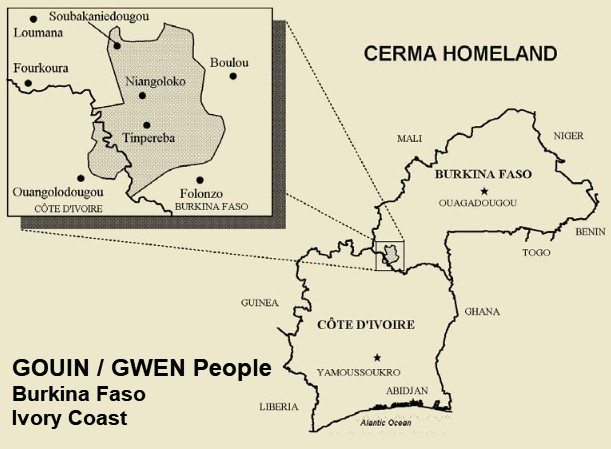
The Gouin or Gwen (sometimes referred to as Ciraamba, Guin, Kirma, and Senufo) are an ethnic group found in Burkina Faso and the Ivory Coast.
They are part of the Gur people and speak the Cerma language.
Gourin group totals 157,700 in 2 countries. The Gouin of Burkina Faso, numbering 154,000 (Peoplegroups.org, 2025)
The Gouin farm millet, cassava, and yams. 78% of Gouin practice their traditional religion.
The Ciramba (also called Gouin or Cerma) are rather small numerically but big on ethnic pride. They live in southwest Burkina Faso, with a few thousand spilling into northern Côte d'Ivoire. The main highway linking Cote d'Ivoire and Burkina Faso runs the length of their traditional territory, which results in a large percentage of Ciramba residing in urban areas.
Most Ciramba follow the local traditional religion, animism, a religious worldview that natural physical entities, including animals, plants, and even inanimate objects--possess a spiritual essence, which, among other things, advocates the power of sacrifices to appease the spirit world. Furthermore, there are approximately 6,000 Ciramba Muslims.
Gouin espeak Cerma language. Many Ciramba know Jula, the local trade language, quite well, but they still cling tightly to Cerma, their mother tongue.
They are receptive to literacy efforts in both Jula and Cerma. In the pilot phase of a new program, the government has two bilingual schools, where initial instruction and materials are in Cerma. The percentage of children enrolled in primary schools is one of the highest in Burkina Faso.
The Ciramba area has a long rainy season, a blessing since most are subsistence farmers. To earn money, farmers sell surplus crops and some women sell baskets, pottery, or shea nuts. The Ciramba work very well together, and will often farm the fields collectively.
A balafon (similar to a xylophone) player often accompanies these groups as they work, sending messages through his music to spur them on.
Family structure is unique in that the maternal uncle holds the most authority in the home. Marriages are often polygamous and two to three generations of a family live together in a compound of mud-brick huts. The land chief, who performs ritual sacrifices, is a village's most powerful individual.
Sources: