

The Meru or Amîîrú (including the Ngaa) are a Bantu ethnic group that inhabit the Meru region of Kenya on the fertile lands of north and eastern slopes of Mount Kenya, in the former Eastern Province of Kenya.
The name "Meru" refers to both the people and the region, which for many years was the only administrative unit. In 1992, the Greater Meru was divided into three administrative units: Meru Central, Nyambene, and Tharaka-Nithi (Tharaka and Meru South).
After the promulgation of a new constitution in Kenya on 27 August 2010, the Greater Meru was further re-defined and now consists of the twin counties of Tharaka-Nithi and Meru.
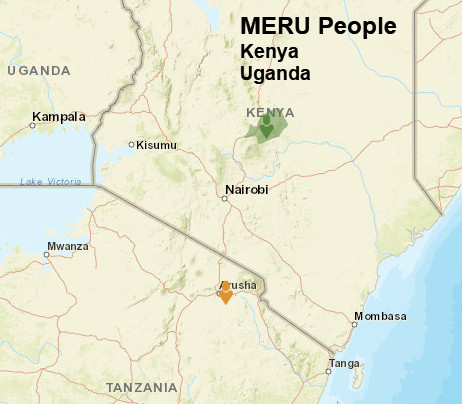
The Greater Meru covered approximately 13,000 km2 (5,000 sq mi), stretching from the Thuci river, on the border with Embu County in the south, to the border with Isiolo County in the north.
The Ameru people comprise nine sections:

The Meru people divide into several groups, all descending from the Baritu ethnic group: Imenti, Igembe, Muthambi, Egoji, Mwimbi, Chuka and Tharaka. In this large bantu Meru tribe there is also the group called Tigania, though this should be considered (we should say: should have been considered) as descending from the nilotic-hamitic root, that is, that they are in practice people left there by the Maasai, when raiding or journeying through the northern regions of Kenya. A careful observer will immediately notice that the Tigania offer different characteristics in many little things, such as spears, shields, women ornaments, dresses, etc... Very similar to those of the Maasai people. The different origin of the Tigania people might account for the poor relationship between the Tigania and their neighbours. History says that Meru people carne from the Coast, somewhere near Malindi. Around the years 1300 Somalis invaded the coast reaching Malindi, driving away the local habitants, who fled in search of new lands. The invasion took place in the typical form of a wedge: after defeating the local inhabitants, the invaders pushed forwards dividing them into two groups: one went to the North and the other South.
In the South, even today, lives the Nyika tribe, with characteristics very similar to the Meru; those who fled North hid themselves along the river Tana and here they settled, though the place was not so fertile: they are the people now called the Pokomo, who in many aspects are similar to Meru.
Since the language of the Meru people is a Bantu language, they have traditionally been classified as Bantu. Some studies on Meru history shows some of the Meru are Cushitic in origin. Language history can be more easily reconstructed, but ethnic merging is more subtle. Insights are provided by the complex oral traditons of multiple origins. The Meru groups themselves have multiple myths or legends of origin, indicating they are actually of mixed origin.
Some claim an origin from the north or west, while others claim coastal origins. Cushites referred to as Mwoko in Meru traditions were already living there when the Bantu groups arrived in the Mt Kenya area in various stages of migration. Other Bantu-speaking peoples in central Kenya have a multiple orign.
This is, in fact, the case with most peoples of the Eastern Africa region, which has experienced a swirl of movement and settlement, displacement and resettlement, through all the oral and recorded history we know. All the Bantu languages of the Mt Kenya region are very similar, as well as cultural patterns. The Meru are most closely related to the Chuka, but share many similarities with the Embu and Kikuyu as well.

The languages of Meru, Chuka, Embu and Kikuyu are somewhat understandable to one another with some substantial differences. The Meru speak at least seven different dialects, but the Bible translation being used is in the Imenti dialect. The differences in the dialects reflect the varied Bantu origins and influences from Cushite and Nilotic, as well as different Bantu, neighbors. As a whole Meru exhibits much older Bantu characteristics in grammar and phonetic forms than the neighboring languages. Even so, it still bears a close resemblance to Kikuyu and Kamba.
The Meru have fairly strict circumcision customs that affect all of life. From the time of circumcision, boys no longer have contact with their mother and girls no longer have contact with their father. A separate house is built for the sons and the mother leaves their food outside the door. This does vary to some degree depending on the level of urban influence, but is still practiced in Meru town. This is one of the major reasons that all secondary schools in Meru are boarding schools.
The Meru are primarily agrarian, with some animals. Their home life and culture is similar to other Highland Bantus. The Tharaka live in the dry desert area, a much harsher life than most Meru. Meru have had a strong educational foundation has been provided by Christian mission schools.

The Meru, for centuries, kept alive the legendary figure of the Mogwe. He should not be confused with the Moga — or typical witchdoctor. The right to be elected Mogwe was hereditary, passing from father to son, not necessarily to the first bom: his duty was to lead the people in paying tribute to God, either by offering the sacrifice of propitiation (to pray for rains and consequent good grazing) or of expiation (whenever a serious fault was committed by a group or an individual of the tribe).
Not all groups of Meru had their Agwe (plur. of Mogwe): Chuka, Imenti, Igembe and Tharaka only were having this particular leader. The Agwe of Chuka and Imenti left their duties long ago without successors. The one of Igembe converted to the christian faith in 1974. The only one still on duty is the mogwe of Tharaka. (A very interesting book has been written by a missionary: "The Mogwe — a failing prophet"). Another outstanding figure was that of the "Diviner". Today, this character has almost completely disappeared. Many divinations were based on particular natural indications (e.g. the divining of the coming of the rains), but some others have something mysterious about them... that one does not know how to explain: for instance the case of the Igembe Diviner who foretold the arrival ¡n the region of "men dressed in white long robes" (the missionaries in white cassocks).

It is to be noted that this foretelling was done at the beginning of the century, some ten years before the first missionaries appeared in the region. For many centuries the Meru people were ruled through a gerontocratic system (in which elders have maximum authority), by a particular restrict circle of elders called Njuuri.
When there were serious matters to be settled these elders would meet in a large field near Tigania, not far from the Uringo forest, "sitting on the grass" (to "seat on the grass" reads for discussing, judging). This was, time ago, the most famous and secret place for gathering of Njuuri. They would gather there from all parts of Meru District. To mark the place, a sanctuary in form of a hut has been built more than twenty years ago, but never used anymore as a meeting point. The elders of the tribe were divided into three ranks: the first was made up of the Areki (sing Mwareki): it was like an honour for a man and a woman to be counted into this rank.
The second rank was formed by the Njuuri Nceke and the third by the Njuuri Mpingiri. The elders forming the last two ranks were carefully selected; one could say segregated from the rest of the tribe. In order to be elected Njuuri, a candidate had to pay a heavy fee, consisting usually of a number of animals, which had to be sacrificed and eaten during a great feast. Each Njuuri — and this practice persists even nowadays in the Igembe region — was to have a particular mask painted on his face while performing rites or gathering for solemn circumstances. The distinctive ornaments of the Njuuri were (and still are): the morai or knotty stick cut out of a branch of black wood (usually ebony wood); the ncea or ring of pearls on the head; the meu or wisker made from the hair of the tail of an animal (usually cow or even giraffe) and the three-leg stool cut out of a single piece of wood.
Some Njuuri add a kind of headgear made from the skin of the guereza monkey (for instance when these Njuuri are heads of the villages, or the agwe, or witchdoctors...) and a large mantle made from the skin of a ram or of a monkey. The Kagita (indigenous tribunal) had authority over all the Njuuri and the tribe; it consisted of the most renowned Njuuri, the Mogwe, the witchdoctor, the headman. They use to assemble in a particular large hut called nyumba ya kagita.

Only very serious crimes against community were judged in the nyumba ya kagita. And usually the accused man, criminal or not criminal, once sentenced by kagita, had to pay with his life. Judges had to find absolutely a scapegoat. Justice was administered as follows: members of the kagita together with the accused person would enter by the main entrance of the hut. Wearing all paraphernalia’s and sitting on the three-leg stools, snuffing abundantly, everybody had to speak and repeat and make comments on the trial. In the middle of the centre of the elders, near the accused person, a large gourd stands, filled with sugar cane wine. But not all is wine; a good quantity of poison is mixed with the beverage; since the poison is heavier than wine, it sinks to the bottom of the gourd.
The sentence against the supposed criminal — once entered the kagita hut — was always a capital one. But had to be proved with the poison test. The first of the Njuuri elders using a little gourd as a spoon, would take some of the wine, being careful not to touch the bottom of the container, and drink of it saying: "I drink this wine so that it may bring joy to my belly, because I am innocent..." The second judge would follow and then the third, the fourth and so on up to the last. Only then would the condemned come up: to him the last judge would offer wine taking it deeply from the bottom of the gourd: "Drink of this wine — he would say — and let us see whether you also are innocent!".
The poison would act in less than a quarter of an hour... then the poor fellow, already rigid in the spasm of the last minutes of his life, had to be pushed away from the hut, by means of stiks and thrown out through a small hole cut out in the wall of the hut, opposite to the main entrance. A hole which had to be closed immediately so that the spirit will miss the way and never find the "traitor" of the tribe. This was just one of the methods of administering justice; many other interesting and peculiar ways were left to the immagination of the judges, like the fire-test, the mushroom-test etc...

Uses and customs of the Meru people are much diversified and the majority of them concern the initiation. But better to say that they cover a whole series of rites and the initiation itself extends to a long period of life of each member of the tribe; we could almost say from his first cry at birth to the time he is considered a real man, or even more, to the biggest privilege when he becomes Njuuri of the top rank. The central part of the initiation is, for boys and girls, the circumcision. (For the girls it consists in the clitoridectomy. Infibulations — a peculiar method among somali and arab people — is unknown).
But much earlier than the circumcision age, the future member of the tribe goes through a series of exercises and rites that often assume deep moral significance. The newly born child is immediately offered to Murungu (God): it is a marvellous ceremony performed by the mother, even before taking care of herself, by holding the baby that has just come out of her womb, and facing Mt. Kenya or Mt. Njombeni, offering it to God, by spitting on it some saliva. (Spitting saliva — gwikia mata — is for the Meru a sign of good wish and blessing).
For five-seven years oíd children will follow the "Kiama kia ncibí' and the rite of "gotumerua ota" (for little boys) and "gotumerua ncia" (for little girls): this is a rite during which the parents instruct their children on a kind of a decalogue, followed by a long list of maledictions and curses... so for example: "Do not steal. If you will ever steal, may your throat be cut like that of this goat"... the goat that is to be sacrificed at the end of the ceremony.
The "kiama kia lamallé" is a rite whose actors are the youths who will take care of the preparation for the circumcision ceremonies.
The "kiama kia nkomango" is instead for youths already circumcised. Another kind of initiation concerns the Njuuri. I It is a most complicated though marvellous series of rites interwoven with symbols displayed with ingenious imagination, wrapped in mystery and intended — possibly — to hypnotize the person concerned. It is for the candidate like a new birth (adoptive fathers and mothers are chosen) into a new grown-up life, during which he is instructed in the so-called secrets of the tribe. Less and less nowadays do the circumcision rites assume the solemnity and participation of people that they used to have a long time ago. Nonetheless it is possible to encounter, while travelling, groups of boys dressed in peculiar little gowns, carrying long wooden spears with an handful of grass attached to the tops, going from hut to hut, singing their monotonous songs to let everybody know that soon they shall become men. The large hut-dormitory (keraro), in which the newly circumcised were to spend days and days, even up to more than a month, has become something very rare. By the way... it must be remembered that the hut-dormitory (and the nyumba ya kagita too) becomes taboo when the circumcision rites are over.
Nobody will be allowed to demolish or to burn it. In the past, to do so could bring down on the profaner the death penalty. Time and white ants little by little will destroy it and make it disappear. The people of Meru though monotheist and believing in only one God (Murungu), to whom they offer prayers and sacrifices, keep in the background magic rites to the spirits (ngoma). It is difficult to say what exactly these spirits are. Are they the spirits of the ancestors who fight against the human beings because they had been wronged? Unknown powers that cause the evil which exists in the world? (because it cannot possibly — according to their minds — come from God who is considered good). Or these two things together? The evil power is called Seitani.

Women then, especially in the Igembe region, have their own spirit-protector: NTATO the python. The animal is considered also the spirit-protector of the rain. It is taboo to kill a python. It is also — we should say "It - was" — taboo to touch the dead. The hut in which somebody died had to be destroyed. Those who realized that a neighbour of theirs was going to die, would take him into the forest immediately and would shelter him in a little hut put up there, significantly called the "hut of death". The deceased's name had not to be mentioned anymore. If the first born died, the following child would be called after the name of an animal, possibly a fierce one like the ¡ion or the hyena, so as to scare the spirit that had already taken the first born.
If unfortunately even the second born was to die, the third born had to be given a name that translated means: "I have no name". By doing so, the spirit would be cheated and it would never know the person. There is proven evidence that in Meru region, not far from Muthara (Tigania) up to a few years ago, a peculiar practice continued, called "the seventh year sacrifice". Which could be said, in few words, to be a human sacrifice.
During the circumcision ceremony of the seventh year (a most solemn one), the first boy to be circumcised was eliminated by pouring poison on the blade of the knife used for the circumcision. They said that this had to be done to appease the spirit.
Actually it was sometimes an occasion of fight between certain influential persons (like chiefs, witchdoctors...) who would seize that opportunity to eliminate the sons of their competitors. In fact, it was because of the rivalry between the chief and the witchdoctor of Muthara, who both wanted their respective son to become number one in the tribe, that the news carne to the knowledge of the colonial authority. With a cunning compromise worthy of a thriller story, and with the help of the local missionary, the authority brought this peculiar ceremony to an end forever. And on that very last performance of the "seventh year sacrifice" it was the witchdoctor who lost his life.
Traditionally, the Meru followed persons called "Mugwe" who served as a prophet and spiritual leader. Mugwes still exist today but are said to have only an ornamental purpose. In the days of mission comity agreements, Meru was given to the Methodists. Methodism has therefore become the primary religion of the region. In many cases, church membership is a cultural rather than spiritual matter.
Depending upon who one asks, Meru history spans about 270 years. There are no written records for the first 200 and what may be learned must come from memories of the community's elders. The predominant tradition has to do with a place called "Mbwa." This tradition tells how the Meruan ancestors were captured by the Nguuntune (or Nhuuntune, meaning "Red People") and taken into captivity on the island of Mbwa. Some analysts interpret this "Red People" tradition as referring to Arabs.
Because conditions were intolerable, secret preparations were made to leave Mbwa. Some analysts interpret Mbwa as re;ated to present day Yemen. When the day came to leave Mbwa, a corridor of dry land is said to have been created for the people to pass through the Red Sea. They later followed a route that took them to the hills of Marsabit, eventually reaching the Indian Ocean coast.
There they stayed for some time; however, due to climatic conditions and threat from Arabs, they traveled farther south until they came to the River Tana basin. The Chuka separated from them there, and inland toward Mt Kenya. Most traditions say the rest went as far south as Tanzania until finally reaching the Mount Kenya area.
There is a confusion here, since you cannot get to Mt Kenya by going south form the mouth of the Tana River, as the mountain is northwest up the Tana from there. They could have gone south, even as far as what is now known as Tanzania, and then swung inland and back northwest.
This confusion or combination of geographical features and directions seems to combine two separate myths of origin from different segments of Meru ancestral history, one from the north and another from the east. In trying to make sense of the confusing geography of the oral tradition, some identify Mbwa with Manda Island near Lamu and the water as the ocean channel. The eastern origin tradition indicates westward migration from the coast. This correlates with traditions of other Bantu peoples like the Giriama and the Pokomo.

In the past the Meru were in a coalition with the Embu and Kikuyu which yielded some political power. The coalition, called Gikuyu-Embu-Meru Association (GEMA), is not as strong as it once was, but the Meru typically voted with the opposition. This does vary from location to location, but would generally hold true. Developments under the multi-party experiment since 1992 renewed an informal political alliance between GEMA peoples and much of the Luo "community." It is not clear how the political situation of position of the Meru has been affected by the political-ethnic violence that scoured Kenya in the first half of 2008.
The Ameru have since the 17th Century been governed by elected and hierarchical councils of elders from the clan level right up to the supreme Njuri Ncheke Council. To become a member of the Njuri-Ncheke is the highest social rank to which a Meru man can aspire. The elders forming the Njuri-Ncheke are carefully selected and comprise mature, composed, respected and incorruptible members of the community. This is necessary as their work requires great wisdom, personal discipline, and knowledge of the traditions. The Njuri Ncheke is also the apex of the Meru traditional judicial system and their edicts apply across the entire community.
The functions of the Njuri-Ncheke are to make and execute community laws, to listen to and settle disputes, and to pass on community knowledge and norms across the generations in their role as the custodians of traditional culture. Local disputes will invariably first be dealt with by lower ranks of the elders (Kiama), then the middle rank (Njuri) and finally the Njuri-Ncheke. However, Njuri Ncheke does not handle matters involving non-Meru people, or those that are expressly under the Kenya's common law. The determination of cases by the Njuri Ncheke, just like is for common law, relies a lot on case law and precedence.
A lesser known, yet important function of the Njuri-Ncheke, is the overseeing and enforcing the rules and regulations controlling the use and conservation of open grasslands, salt-licks and forests. Their work as conservators extends to the preservation of the Sacred Sites.
The Njuri Ncheke is also influential in the socio-economic and political decision making amongst the Meru. The Council of Elders spearheaded the establishment of the Meru College of Science and Technology and donated 641 acres of community land in 1983 for its siting and development. The college was in 2008 upgraded to a University College of Jomo Kenyatta University of Agriculture and Technology (JKUAT) and in early 2013 awarded a charter by H.E Mwai Kibaki - the then President of Kenya and renamed Meru University of Science and Technology(MUST). Njuri Ncheke is represented in the University Council.

The Meru are primarily agrarian, and their home life and culture is similar to other Highland Bantus. The Meru have maintained adherence to a fairly strict customary code amongst the various cohorts of the population. For instance circumcision is a mandatory rite of passage for boys during which time cultural education including community norms and expectations, such as respect for elders and protection of children are taught in a seclusion period that may last up to a month. As a matter of principle, young men must ensure minimal contact with their "Mothers" after initiation. Nowadays however the depth of instruction varies depending on the extent of urban influence. Previously, girls would also undergo circumcision, but the practice was outlawed by Njuri Ncheke in April 1956. The practice has been progressively abandoned and is being replaced by instruction based alternative rites of passage.
Typical Meru cuisine includes nyoni (mashed green peas or beans; traditional vegetables; and arrowroot, yams or potatoes), gîtwero (mashed banana), kîthere or mûthere (unfettered corn seeds cooked with beans or peas), nyama cia gwokia (roasted meat), ūkie (fermented porridge made from flour of corn, millet or sorghum), and rugicu (a mixture of honey and meat).

The Meru have had a strong modern educational heritage provided by the Christian missionaries. The main education institutions were started or sponsored by the Catholic, the Methodist and the Presbyterian Churches. The Greater Meru has numerous institutions of learning including primary schools, secondary schools, teacher training colleges, nursing schools, technical institutes and Universities. One of the most prestigious chartered private university in Kenya, KEMU was the first to be established in the area in 2006. Two chartered public universities, Chuka University in Tharaka-Nithi County and Meru University of Science and Technology (MUST) at Nchiru- Meru County have since been established. Several other institutions of higher learning including the University of Nairobi, Egerton University, Kenyatta University, Co-operative University College, Nazarene University and Mt. Kenya University have established their satellite campuses in the area, making the Greater Meru a key education hub in Kenya
The Ameru are primarily agrarian, growing a variety of crops and keeping livestock. The Greater Meru is endowed with soils and climatic conditions that allow for the production of a variety of commodities including wheat, barley, potatoes, millet, sorghum and maize. High grade tea, coffee, bananas and miraa (Khat) are the key cash crops. The Meru were indeed the first Africans to grow coffee in Kenya in early 1930s upon the implementation of the Devonshire White Paper of 1923. Other crops include groundnuts and a wide range of legumes, vegetables and fruits. The Meru are also keepers of livestock both for subsistence and commercial purposes. These include dairy and beef cattle, goats, sheep, poultry and honey bees. Besides, the area has huge potential for tourism by virtue of hosting the Meru and Mount Kenya National Parks and the Lewa Conservancy. Mining activity is also expected to pick up once the ongoing exploratory works on the iron-ore deposits in Tharaka are completed.

The Ameru wield a lot of political influence in Kenya mainly due to their astute and strategic political organization. The community has not produced a President for the Republic of Kenya so far. However, members of the community have always held some key and strategic positions in the governments of the day. In the early years of Kenya's independence, the Meru were in the Gikuyu-Embu-Meru Association GEMA, a political mobilization outfit formed during the reign of Mzee Jomo Kenyatta. GEMA was however formally banned in 1980 during a national consultantive conference at the Kenya Institute of Administration, Kabete under the chairmanship of President Daniel Arap Moi, but since the advent of plural politics in Kenya in 1992, the Meru have largely voted with the Embu in all subsequent presidential elections.
In the non-presidential election, most constituencies in the Greater Meru vote in candidates based more on their individual merit than on the basis of the sponsoring political party. This particularly manifested itself in the general elections of 4 March 2013 where the Orange Democratic Party (ODM) captured two seats (Hon. Cyprian Kubai Iringo MP for Igembe Central and Hon. Mpuru Aburi MP for Tigania East) in Meru County despite the predominance of the Jubilee Coalition in the upper Eastern and Central Kenya region. The elections also saw the historic election of Hon. Rahim Dawood, a politician of Asian origin to represent Imenti North Constituency and Hon. Kinoti Gatobu, a 26-year-old independent candidate elected to represent Buuri constituency. Subsequent to the same elections, Prof. Kithure Kindiki, an International Constitutional Lawyer and a first time Senator (Tharaka-Nithi County) became the Majority Leader in the Senate.

The historical and cultural artifacts of the Meru are preserved at the Meru Museum, formerly the colonial DC's office located in Meru Town. The Njuri Ncheke Shrine at Nchiru is also gazetted as a heritage site and placed under the care of the National Museums of Kenya. The Shrine is accessible and open to the public most time of the year unless there are Njuri Ncheke activities at the site. Members of the Njuri Ncheke, though bound by a strict oath of secrecy, can also provide valuable and authoritative information and insights into the Meru traditions and culture dating back to the yore and transmitted through generations.
Sources: