
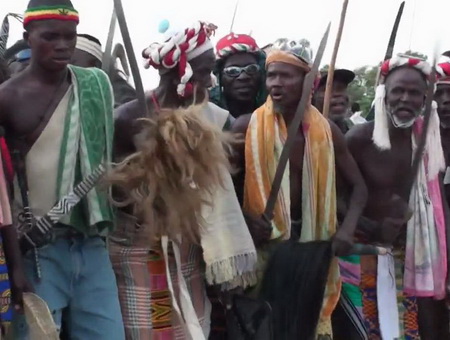
Tallensi, also spelled Talensi, are a people of northern Ghana who speak a language of the Gur branch of the Niger-Congo language family. They grow millet and sorghum as staples and raise cattle, sheep, and goats on a small scale. Their normal domestic unit is the polygamous joint family of a man and his sons (and sometimes grandsons) with their wives and unmarried daughters. Married daughters live with their husbands in other communities, commonly nearby.

Talensi, Talansi, Talense, Tale, Talen, Talene.
Major sub-groups are Tallis ("real Tallensi”) and Namoos (assimilated newcomers).
The Tallensi are a group of sedentary farmers living in widely scattered compounds in northern Ghana. They constitute a homogenous group both culturally and linguistically, but do not show strong political unity as an ethnic group in the sense ethnicity is commonly manifested and experienced. A majority of the Tallensi live in the basin of the Volota River in northern Ghana. But they have no fixed territorial boundaries, nor are they precisely marked off from neighboring groups by cultural or linguistic usages. Tallensi culture is especially similar with that of neighboring Namnam and Nankanse. To this effect, an anthropologist who surveyed the area in the 1930s doubted whether it was necessary to deal with the Tallensi as an ethnic group distinct from these two neighboring groups (Rattray, 1932: 339).
In 1931, the Tallensi numbered 35,000 (Fortes, 1945:4). In 2003, the total number of all Gur-speaking peoples was estimated to be 820, 000. The Tallensi constitute a significant section of this population, but their current size is not accurately known as these linguistic data are not disaggregated by dialects.
It has been variously described as ‘parkland’, ‘savannah’, or ‘orchard bush’ country, terms which indicate the sparse and uniform forestation characteristic of this zone. Stretching irregularly and almost right across Africa, between the eight and the sixteenth parallels N. latitude, it merges into the Sahara on the north and is bounded by the tropical rain forest on the south.”
“The climate of the Sudanese Zone exhibits two clearly defined seasons, a dry season lasting about half the year (October to March) and a wet season lasting the remaining six or seven months (April to October). A characteristic feature of the dry season is the harmattan, a hot parching wind laden with fine
dust which blows from the Sahara, so strongly at times as to obscure the landscape in a haze which limits visibility to a few hundred yards.
Heavy dew and mists cause the mornings to be chilly and bracing… p.m the sun blazes relentlessly through the faint haze; sunset ushers in a cool and balmy evening; and night brings a relatively marked drop in temperature.”
“Violent nocturnal tornadoes from the east and north-east, accompanied by lightning and thunder, introduce the rainy season, during which the prevailing wind blows from the direction of the Gulf of Guinea, to the south and south-east. During this season the temperature remains fairly stable throughout the day. Though it is never as hot as in the hottest days of the dry season, the humidity makes it at times excessively oppressive.”

The Tallensi speak Talni, a dialect of Farefare, part of the Gur branch of the Niger-Congo family.
Tallensi people speaks Talni language,which is a branch of the Gur language group of the larger Niger-Congo language phylum. Gurune, Nankani, Booni, Talni, and Nab't together with some others are considered the major dialects of the Frafra people. However, Nab't and Talni could also be considered dialects of Mampruli; Mampruli, Kusaal, and Dagaare are in turn considered to be sister languages to Gurune. There are obvious linguistic similarities among these and the other languages of the Mabia language group (Bodomo 1994; St. John-Parsons 1960).
The Tallensi think of themselves as divided into two major groups; the Hill Tallenis (real Tallensi) whose ancestors “sprang from the earth,” and Namoos (affiliated Tallensi) who migrated from an area called Mampurugu (Fortes, 1945: 22). Both groups lived with no central government, until they were finally conquered by the British in 1911 (Fortes, 1945: 24).
The British ruled Tallensi by elevating a former clan chief of Dagomba origin into a paramount chief. The Paramount Chief in turn appointed many chiefs as his representatives in different parts of Tallensi society (Fortes, 1945:6).
British rule had reportedly little impact on Tallensi culture. By 1936, for example, Fortes (1945:12) reported that there was only one Tallensi child who continued in school to graduate with “a moderate command of English and the three R’s” [reading, writing and arithmetic]. Likewise, missionary activities were reportedly limited only to an occasional visit to one Tallensi settlement.

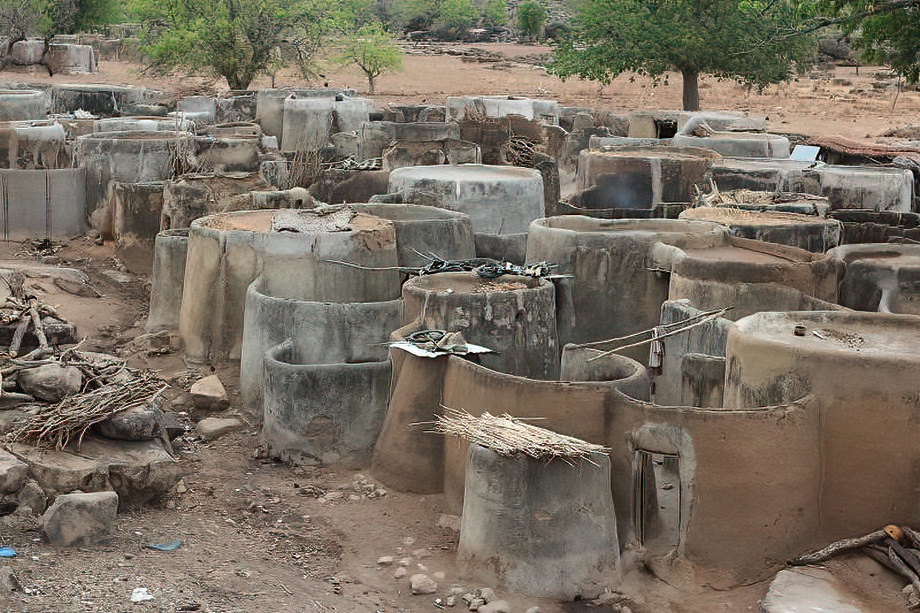
In the old established settlements, Fortes observed a very close correlation between lineage proximity and residential proximity among members of the clan who live there. Close agnates tend to live near one another so the residential proximity is almost a measure of lineage proximity. A segment of small area tends to be a close residential cluster and segments of larger area, up to major segments of a maximal lineage, tend to form residential blocks (Fortes, 1945: 207). This correlation between kinship and proximity in physical settlement is is supported by evidence from recent ethnoarcheological research (Gabrilopoulos, et.al, 2002: 231).
The Tallensi are settled farmers. Their traditional subsistence centers on cultivating millet and sorghum as their staples. They also raise sheep, goats, cattle, horses and donkeys on a small scale. Other domestic animals include chickens and guinea fowl which are especially needed for rituals and sacrifices. Most people obtain additional income from a combination of gathering, hunting and fishing.
Most families are able to produce common articles such as hen-coops, baskets, bows, adze-shaft, etc. Some more skilled men and women produce a few items for sale, especially during the dry season.
Some Tallensi are skilled blacksmiths, leather workers, and potters. But Fortes found their number to be "exceedingly few"(Fortes, 1945:10). Craftsmen produce their crafts only in their spare time, mostly during the dry season when there is no farm work.
The bulk of agricultural labour falls to the lot of men, though women and children help in planting.” This all important agricultural production is organized through the joint family, living in one compound, under the leadership of the compound head. He is responsible for the sorting, selection, preservation and storing of grain, the control of distribution, the organization of labour, etc. He also holds the land from which the unit of food economy gains sustenance.” The men do the heavy work of farming and care for the livestock.
The most exacting task in a woman’s routine is the provision of firewood and water. Little time can be available for more direct participation in production, especially as cooking, the most important task for the woman, must take up a considerable proportion of her time. She usually prepares two meals per day, and must always provide relish and contrive some variation in the meals.”

Many Tallensi men and women earn additional income from petty trade in food crops and imported consumer goods. Some grow cocoa, introduced by the colonial government, as a cash crop.
All compounds share in the export trade in fowls; wage-labourers bring money back home. Fifty-four percent of compounds own some cattle, which are principally used in marriage transactions, but also serve as a marketable reserve in time of famine, an advantage enjoyed by owners of large herds over others.
Livestock are increasingly used as commodities in ordinary exchange, rather than in marriage transactions alone. Great quantities of cloth are imported and must be paid for. Yams and other foodstuffs are imported.
There are markets in Taleland. In the past the principal one was at Ba’ari; this used to be raided by men from the Tong Hills. Foreign trade was also carried on with caravans on the North-South route…
Patrimonial land is inherited within the lineage from fathers to sons in order of seniority by generation or
by age. It is plain that such land cannot provide for the needs of rapidly-growing lineage, and the records
of borrowing, pledging, and sale of land, together with evidence of migration, make this clear.
The keystone of the institutional framework of Tale agriculture is security of land tenure…The landowning unit is a segment of a maximal lineage and its property are an aspect of its corporate relationship to the maximal lineage and clan. Within a settlement the stretch of land parceled out into farm plots corresponds to the clan occupying that locality as it segmented into a hierarchy of lineage units.
All segments of the clan of the same order are equal to one another. They have an equal weight in the
structure of the clan, equal power in its affairs. The have, in consequence equal property right (though not necessarily equal amounts of property), equal opportunity for holding and farming land (though not
necessarily equal achievement), and equal social duties to one another…Just as members of the same clan
must not kill one another or abduct one another’s wives, so they must not trespass on one another`s land. For this would wreck the mutual loyalties of segment to segment and make impossible the maintenance of the reciprocity of rights and duties on which their corporate life depends. There is, in other words, a general
body of jural and moral norms, binding on all members of the clan and cementing its solidarity, and supported by the powerful sanctions of the ancestor cult and the Earth cult. The security of land tenure is
guaranteed by this.
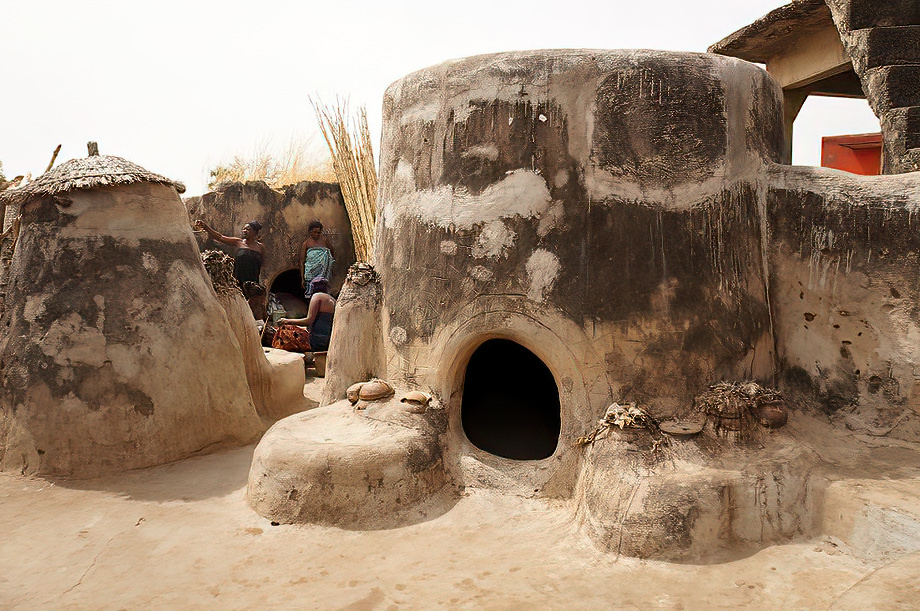
Fortes described the Tallensi as strongly patrilineal in their descent system and “patrilocal in their residence pattern. Patrilineal kin groups are organized into an elaborate clan system. Each clan, or “maximal lineage” in the words of Fortes, consists of descendants of a common ancestor 8-10 generations back. The clan is further divided into minor minimal lineages which functions as the land holding units. Each minor lineage is in turn divided into minimal lineages consisting of the children of one man. Each of these sociological levels is a corporate unit known by the name of the common ancestor. Political and religious functions are invested in the maximal lineage, while a person’s settlement pattern and property relations are associated with membership in minor and minimal lineages.
The Tallensi used a combination of descriptive and classificatory kinship terms. Avuncular and nepotic terms are of bifurcate merging type, while cousin terms are descriptive. Terms for wife are extended to the wives of siblings.
The Tallensi have one of the most consistent patrilineal and patriarchal family systems as yet observed in Africa . At the peak of the cycle of family development the homestead is normally occupied by family group consisting of an old man his adult sons and possibly sons together with the wives of these men and all their unmarried children. This is the ideal every man aims at. Three generation patrilineal polygynous families are common.
By the rule of lineage exogamy daughters marry out Men are born grow up and live their lives in the same place and often homestead. Even if they spend many years working in Southern Ghana they can and normally do return freely to their natal homes when they wish to do so. Women live in their parental home as daughters and move to their husbands homes as wives and though the physical distance of the move may be less than mile the social distance is felt to be significant. Furthermore the men of lineage united by ties of common patrilineal descent which go back many generations tend to live near one another.
Since by the rules of classificatory kinship they are all brothers fathers and sons to one another the feeling of family solidarity embraces whole cluster of kinship-linked parental families each of which however has its separate house or part of house. Thus the core of every community is group of patrilineally linked men and it is they who hold the reins of authority and power in regard to land and livestock the control of women and children and especially in the all-important religious cult of ancestor worship.
At the same time women have remarkable degree of autonomy. Throughout life they keep in close touch with their own parental kinsfolk Indeed as among other African patrilineal peoples the brother plays an important part in life as the indulgent protective non-authoritarian counterpoise to the father and paternal kin wife with children is entitled to have her own apartment which is the private domain of herself and her children.
The room both in reality and in the imagery and conceptualisation of family structure is the heart of the family. Sexual relations between husband and wife are prohibited from the time of birth until it can run about and feed itself. Thus children are normally spaced at three-yearly intervals approximately and immediately successive matri-siblings are believed and expected to have strong feelings of rivalry which they often display in early childhood
From point of view then his life space falls into series of zones corresponding to successive stages of development. The innermost zone is centred on his mother and her room next comes the zone of the father-centred homestead associated with the ideas of half-siblingship and of paternal authority and then operative increasingly after the age of about five the cluster of related families contrapuntal pattern of social organisation in which patrilateral and matrilateral relationships are balanced against each other is fundamental in all spheres of Tallensi social structure and personal attitudes.
Attachment to the family and respect for the father remain so strong that educated young men working as clerks teachers etc. continue to live in their parental homes and to contribute to the family income just as their fathers did before them.
Men and women take equal delight and show equal affection and indulgence in looking after their young children. Corporal punishment is very rare. Obedience to parents is built into the domestic routine and the value system rather than enforced by coercion Individuals even quite young children have large measure of independence within the framework of duty to the family.
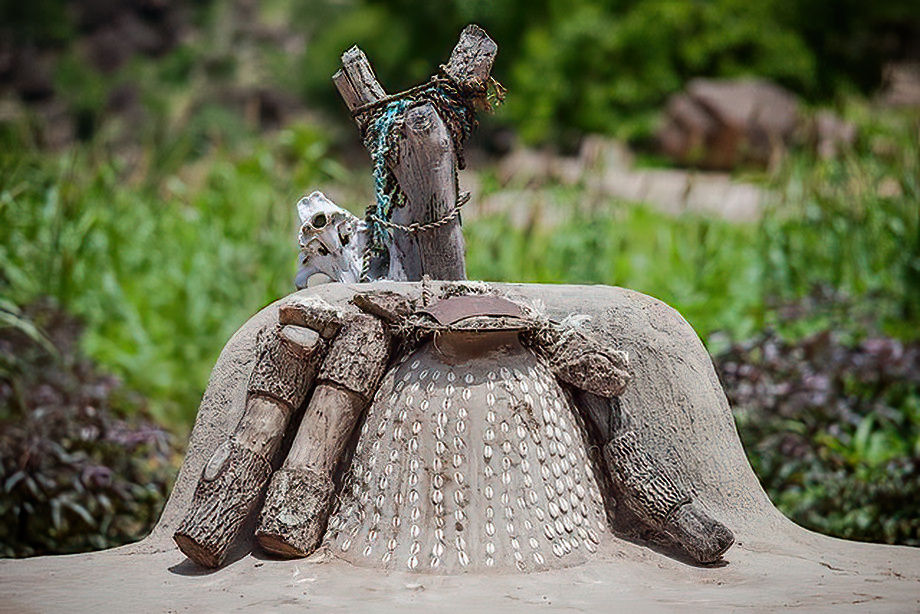
Notable aspect of Tallensi culture is the way which their family system is mirrored and sanctioned in their ancestral cult. The shrines dedicated to the departed ancestors are placed all over the homestead and when not receiving sacrifice or worship are quite informally used as tables or seats. This shows vividly how the ancestors continue to form part of the family almost as if they were still among them They have in fact been reincorporated in the family in their spiritual identity.
Essentially all ancestors worshipped are translated parents Both paternal and maternal ancestors are thus worshipped. All ancestor figures are invested with mystically punitive as well as but rather more than beneficent qualities but significantly enough maternal ancestors and ancestresses who are extensions of the loving and self-sacrificing mother to whom unqualified affection and trust are due are believed to be more vindictive than paternal ones who represent the respected and legally supreme father.
From the point of view of their descendants the ancestors are perpetually demanding recognition service and propitiation by means of libations and blood-sacrifices claiming the credit for good fortune and more usually asserting their rights by inflicting misfortune sickness and above all death. Being unpredictable their intervention only gets known after the event when diviner is consulted to discover the ancestral agent of an illness or death.
ncestors can be seen as the projection in symbol and concept of the coercive authority and superior power that lie behind the affection and devotion of parents especially fathers for their children In another ancestor worship may be seen as mechanism for dealing with the ambivalence in the relations of parents and children which Tallensi custom openly recognises. For example man and his first born son and prospective heir are deemed to be rivals and are therefore obliged to avoid certain forms of intimate contact and similar rule applies in an attenuated form to woman and her oldest daughter.
Furthermore man does not achieve the status of full jural independence until his father dies no matter what his age may be.
In some ways ancestors are much like small children or very old people noticed only when they make nuisance of themselves by their demands or by getting ill. Then they must be placated and one can relax until the next outburst.

When studied by Fortes in 1934-1937, about 40% per cent of all of the married men in Tallensi were reportedly polygynous. In polygamous families, each wife lives in her own hut in the homestead. The senior wife is regarded as the chief wife. Sororal polygyny is disapproved and the sororate is not customary. Levirate marriages are allowed between people of certain categories.
In Tallensi traditional marriage, "the bridegroom’s guardian must send the placation gift (lu sendaan) to the bride’s guardian, and must pay a proportion of the bride-price acceptable to the latter. A wife is usually espoused (sol) by paying the bride-price of four head of cattle or their equivalent in installments over a number of years. If he does not fufill these jural requirements, a man has no rights to and over his wife.”
According to Murdock, the Tallensi recognize three modes of marriage: 1) elopement with connivance of the girl’s mother or sister, gifts to her parents, and subsequent marriage payment; 2) arrangement between the heads of two joint families through an intermediary (pogosama), who is patrilineally related to the groom and also related to the bride, usually as a son of one her female lineage mates; 3) infant betrothal, in which a rich man gives an advance on the marriage payments to a poor man for his infant daughter. Of these three, elopement is the commonest mode when marrying a first wife.
Traditional Tallensi marriage involves payments which fall into three categories: 1) gifts at marriage, including fowl for sacrifices, 2) a “placation gift” at some time after marriage, consisting of fowls distributed among the elders of the bride’s lineage, and 3) a bride-price, paid at a later data and often in installments, consisting of about four cattle or the equivalent in sheep or money. The bride-price is raised by the head of the groom’s minor lineage and is paid to the head of the bride’s minor lineage. Payments obtained for a girl should be used to secure a wife for her brother. There is also an obligation to do several days a year of agricultural bride service for a number of years after the wedding.
Tallensi society frown s on a woman committing adultery. A woman who commits adultery exposes her husband and children to mystical dangers…she is haled to the homestead of the head of her husband’s medial lineage and subjected to the ordeal of entering the gateway. If she confesses she may enter safely. If not, the lineage ancestors will cause her to get ill if she enters the gateway. This is a powerful sanction of marital fidelity among women and is one reason why adultery is not very common.”
There is hardly a divorce case in Tallensi society, however, a marriage sometimes break up when a woman commits adultery. “A marriage breaks up either through the action of one of the spouses, generally the woman, or through that of the wife’s guardian. The Tallensi have no formal procedure for divorce. If a man wishes to get rid of a wife (which happens very seldom) he generally does so by with-holding the bride-price, so that her guardian eventually recalls her, or he makes her life so uncomfortable that she deserts him. If a woman decides to leave a husband, she simply absconds. She may do so because she dislikes him, or because he does not feed her well enough, or neglects her sexually or otherwise, or, natives say, out of mere caprice. All women, according to the men, are fickle and gullible; a plausible suitor can seduce any woman. So if a young wife goes to visit her parents and stays longer than two or three days, her husband, be he an ardent young man or a sober greybeard, hurries off to fetch her, usually in considerable dudgeon, for fear that she may be abducted by another man.”
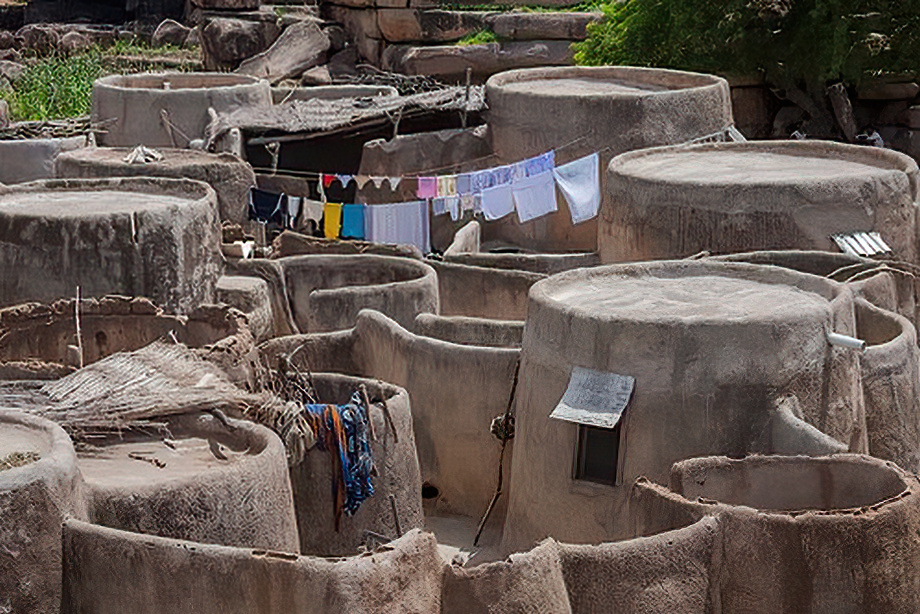
The commonest domestic group is the polygynous extended family consisting of a man and his sons (and sometimes grandsons) with their wives and unmarried daughters. Married daughters live with their husbands in other communities, commonly nearby. As a culturally designated heir of his father, the eldest son must use a separate gate to the compound.
Inheritance is patrilineal. Lineage property (farm land and ancestral shrines) pass from lineage head to his successor by seniority. Individually acquired property (for example, grain, personal belongings, goats and fowl, personal shrines and land acquired by a man's own effort) is inherited by sons. A woman's property is divided among her daughters, but her cattle are inherited by her sons.
According to Fortes, children in Taleland are remarkably free from over-solicitous supervision. Each child reportedly had the maximum freedom and responsibility commensurate with his/her skills and maturity. Parents allowed children to go where they liked and do what they liked, while holding them fully responsible for tasks entrusted to them. As a consequence, children performed a wide variety of useful activities beginning from about age six (Fortes, 1938: 31).
The politico-ritual integration of a Tale clan is focused in the politico-ritual office or offices vested in it or in its component maximal lineages. These offices are either chiefship (na’am) (or its equivalent, the senior office connected with an External Boyar) or tendaanaship. Chiefship is primarily associated with the Namoos, though not exclusively so, tendaanaship with the clans and maximal lineages claiming to be the autochthonous inhabitants of the country, though, again, not exclusively so.
Both chiefship and tendaanaship are, to the natives, unitary institutions made up of offices distributed among a number of clans and lineages. The range of these institutions is not even limited to Taleland. All chiefs are ‘brothers’ since they derive their office from a common source, the Paramount Chief of Mampurugu; all tendaanas, similarly, are ‘brothers’ since their office has the same function and ritual value everywhere in relation to the Earth. The chain of ritual collaboration is one expression of this notion. Among the Tale chiefs the Chief of Tongo ranks highest. He has no political, administrative, or judicial authority over any other chiefs, or any other clan than his own, but his office incarnates the quintessence of na’am. He represents all the chiefs of the country in the ritual attributes of chiefship.Tendaanas, in keeping with the elaborate segmentation of the clans in which this office is vested, are more equal in status. But in every cluster of closely interdependent contiguous clans there is one tendaana who ranks higher than his confreres.
The Gbizug tendaana ranks above the tendaana of Zubiun, Gbeog, and Wakii, and the Doo tendaana above the other Tenzugu tendaanas.
Chiefs and tendaanas had no political power, as we understand it, before the coming of the white man.
They had no administrative, or executive, and only rudimentary judicial powers. They were the leaders and not the rulers, the fathers and not the princes of their clans.
Prior to the arrival of the British, the Tallensi had no judicial system. Rule of law governing rights and obligations in property relations, person-to-person relations, and inter-group relations were enforced collectively by members of lineages and/or sub-lineages (Fortes, 1945: 235).
Hostility and punitive raids between communities were common, but large-scale warfare was rare. The spilling of blood is believed to desecrate the sacred earth (Fortes, 1945: 235).
There are many restrictions and taboos commonly associated with menstruation in traditional Ghanaian thought and practice. There is a widely recognized traditional taboo on a menstruating woman’s cooking food for any man including her husband. It may be thought necessary to protect even crops from her evil influence…She may not be allowed to enter any stream to get water.
“When a boy is 6 years of age, he may not eat from the same dish as his father. This is a taboo. Other taboos relate to the use of the father's weapons, the father's clothes, or the father's tools. Furthermore, when a son arrives at adolescence, around the age of 12 or 13, he cannot enter the house compound at the same time as his father. If, for some reason, the son violates this taboo, then there must be purification rites.
“The firstborn daughter cannot look into her mother's storage containers, vases, pots, or tubs; this is a taboo.”
The dead are buried in small cemeteries. Each settlement or main segment of a lineage has its own burial site, often marked by sacred groves. Each burial site serves as a spiritual center where members of the local community interact with ancestral spirits. The most venerated of these scared shrines is located in the Tong Hills where the founding ancestors of the original Tali were buried (Fortes, 1945: 220).
When a person dies, it is the firstborn son or daughter who leads in the ritual ceremonies. Only at this moment can the son actually put on his father's cap and his father's cloth and walk in the father's shoes.”
Everything in the Tallensi society works together to maintain this balance between the secular lineage and the ancestral dead. “From the point of view of their descendants, the ancestors are perpetually demanding recognition, service and propitiation by means of libations and blood sacrifices, claiming the credit for a persons good fortune, sickness and above all death. Being unpredictable, their intervention only gets known after the event, when a diviner is consulted to discover the ancestral agent of an illness or a death.”
Illness within among members of a man’s extended family is often attributed to his failure for “ensuring the beneficence of ancestor spirits and other mystical powers” (Fortes, 1949: 106).
The Tallensi are polygamous and follow a patrilineal system of kinship and descent. Great emphasis is placed on inheritance and the tensions surrounding parents' relationships with their children. It is considered essential for a man to have a son if he is to achieve fulfillment and be venerated as an ancestor after his death. However, the birth of a first-born son, and to a lesser extent a first-born daughter, is held to mark the culmination of a man's 'rise' in the world, and the start of his decline. Meanwhile, the son grows to replace and supplant the father. The resulting ambivalence between father and son plays an important role in Tallensi rituals and taboos.
Taboos begin when the first-born son reaches the age of five or six. From this time on the son may not eat from the same dish as his father, wear his father's cap or tunic, carry his father's quiver, use his father's bow, or look into his father's granary. When the son reaches adolescence, he may not meet his father in the entrance to the house compound. Similar taboos exist to regulate the relationship between mother and first-born daughter. The daughter, for example, may not look into her mother's storage pot.
Upon the death of a father, his first-born son and daughter lead the rituals involved in his funeral. The son, at this point, puts on his father's cap and tunic. A tribal elder, carrying the dead man's bow, ritually guides the son to his father's granary and shows him the inside. After his father's death the son is considered a mature man for the purposes of ritual, and it is his responsibility to make sacrifices to the ancestors, chief among them being his own father, who being recently dead is held to act as an intermediary between those still living and the more remote ancestors.
It is believed that these taboos and rituals serve to channel ambivalence and resentment between generations into culturally defined and culturally acceptable means of expression.
Among the Tallensi tribe there is a belief in the sacred crocodile. As Meyer Fortes highlighted in his ethnographic work "The concept of the person", special crocodiles in special pools are considered persons among the Tallensi. No local man, indeed no Tallensi would dare kill or injure a sacred crocodile. Every Tallensi knows that these crocodiles are the incarnation of important clan ancestors. To kill one of these is like killing a person. It is murder of the most heinous kind and it would bring disaster on the whole clan.
However, not all crocodiles are considered persons (ni-saal) for instance, in the rivers that are fished in the dry season - is not a person, not sacred. It can be killed and eaten.
Sources: