

The Buyu people, (also known as Basikasingo, Babuyu and Eastern Pende), live between the Lualaba River and the northwestern end of Lake Tanganyika in Democratic republic of Congo.
The Babuye are also called Hemba, Juba-Hemba, Luba-Hemba and Waruwa, are a group of "Balubaized" Bantu tribes whom one source regards as basically non-Baluba.
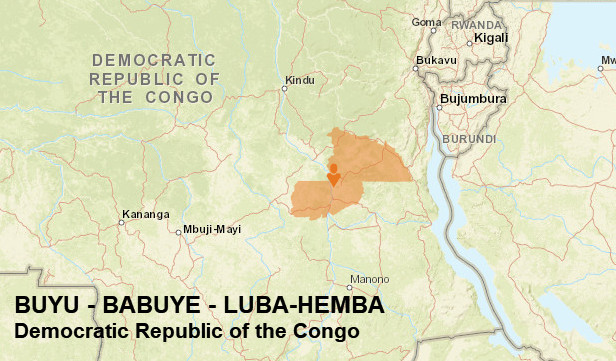
They embrace the Babuye proper, the Goma (Wagoma) in the northeast, the Kalanga (Bakalangani, Bakananga) adjacent to the Goma, the Kunda( (Bakunda) in the east and the Lumbu (Balumbu) in the southeast. The Baholoholo, Bwile, and Hombo are reported to be culturally akin.
The Buyu occupy a small area between the Lualaba River and the northwestern end of Lake Tanganyika, in the eastern Democratic Republic of the Congo.
In this region overrun by innumerable shifts in population, groups of diverse origins coexisted in the same village: Lega, Bembe, Buyu, Bangubangu, and Binji, all of whose primary activity would be the hunt. This occasioned numerous rituals, and it also was an important factor in cultural exchanges and in the mobility of the population. The Buyu population is declining and their culture disintegrating due to the expansion of the Bembe over the past 70 years into their territory.
Among the six clans that form the Buyu ethnic group, three are known predominantly for their male and female ancestor figures. These venerated chiefs of the Buyu led migrations, founded villages, or provided exceptional leadership.
Primarily agricultural, with brand tillage. The staple crop is manioc, but beans, peas, sweet potatoes, peanuts, maize, eleusine, sesame, and a very little millet also are grown; no bananas. Domestic animals include goats, sheep, pigs, dogs, chickens, and pigeons. Cattle arid horses are not kept, and milk is not used. Hunting and fishing are apparently of some importance, and some gathering is done.
Men hunt, fish, and clear land. Women catch small fish, collect wild plants and small animals such as rats, and do all agricultural work after the land is cleared.
Clan lands are mentioned in the literature. Inheritance is matrilineal — by mother's brother, then brother, then sister's son.
The Babuye enslave war captives often marry their women. Freemen reportedly are divided into social classes as follows: royalty (paramount chiefs), retainersrainobled by royalty, a petty aristocracy (the "elders" of villages), and ordinary commoners.
The normal residential unit is a polygynous family.
Villages ape compact and those with chiefs belonging to the ruling class are often large. Settlements are not palisaded, but those of the Goma are built along the crests of ridges for defense. Dwellings are square and have pointed pyramidal roofs. Each village has a bachelors' house, where boys live before puberty.
Mention in the literature of clans and clan-lands suggests the possibility of avunculocal clan-barrios.
Each village has a headman, appointed by the paramount chief, and a prestige group of elders.
There are paramount chiefs, who appoint lesser chiefs and headmen. Succession is matrilineal.
Little is known about Buyu history. The area in which the Buyu now live, near the northern end of Lake Tanganyika, is a diverse mix of cultures, including the Holo, Lega, and Bembe. The population of the Buyu has declined significantly during the last century due to domination by the intrusive, land-hungry Bembe. Additionally, the unchecked civil strife in the area has caused many to flee and assimilate. Despite historical obscurities, their sculpture is now documented and much-appreciated.
The Buyu worship to nature spirits and to ancestors. When bad luck arrives, they try to understand the will of the ancestors either through dream interpretation or divination. The Buyu immortalized their chiefs and ancestors in vigorous figures characterized by a massive head, long, cylindrical torsos, square shoulders, and bulging trunk. The face is triangular in shape. The forehead is marked by circularly arched eyebrows and the eyes have a coffee-bean shape. The jaw dominates the mouth, and the chin is angular. A hatched motif simulates a stylized beard.
These statues are stylistically so close to those by neighboring ethnic groups who also live on the west banks of the lake – such as the Holoholo, the Binji, and the Bangubangu – that it is sometimes difficult to tell the styles apart.
These figures are kept in small huts and are displayed in series of five to seven, and have either a beneficial or a malefic influence on everyday life, so they require a cult and associated offerings. Before leaving for the hunt, the men go there to rub their weapons with white clay; if the hunt has been good, they offer a few trophies upon their return. Sometimes bust figures were also left outside the ancestor shrine, either in the village or in the forest.
The arts of the Buyu have become known to scholars only in the last twenty years. Their primary output are ancestor figures, though one of their sub-groups, the Sikasingo, have produced some fine masks, identified by a triangular border on the face and beard . Precise scarification, square shoulders, and a fierce expression are hallmarks of their statuary, making it very popular with collectors. The Buyu live between the Lualaba River and the northwestern banks of Lake Tanganyika. They have been heavily influenced by larger groups who have dominated them over the years, but the uniqueness of their ancestor figures sets them apart from their more famous western neighbors, the Luba and Hemba. One can also see Tabwa influences. Buyu pieces sometimes appear somewhat rough and hurried, but they can also be meticulously done, full of drama, power, and beauty.
Three of 6 clans from Buyu are known for their male and female ancestor figures. These figures are meant to venerate chiefs of the Buyu who led migrations, founded villages and provided exceptional leadership. The statues used to worship these ancestors are so stylistically close to neighboring tribes, that they are often mislabeled.
Sources: