

The Hadza, or Hadzabe, are an indigenous ethnic group in north-central Tanzania, living around Lake Eyasi in the central Rift Valley and in the neighboring Serengeti Plateau.
There are, as of 2015, between 1,200 and 1,300 Hadza people living in Tanzania, although the increasing impact of tourism and encroaching pastoralists pose serious threats to the continuation of their traditional way of life.
Genetically, the Hadza are not closely related to any other people.

The Hadza are a population of hunter-gatherers living in a 4000 km² area around the shores of Lake Eyasi, which sits at 1020 meters above sea level on the floor of the Great Rift Valley at the base of the Serengeti plateau in Northern Tanzania, East Africa. To the southeast of Lake Eyasi there are a series of rocky hills reaching 1500 meters altitude that include many small water sources and appear to be preferred sites of Hadza occupation.
Much of the area can be characterized as wooded savanna, with plentiful trees (e.g. Acacia sp., baobab [Adansonia digitata]) and plentiful grasses. Rainfall averages 500 mm per annum with extreme seasonal, annual, and historical variation, and is much higher on the surrounding highland plateau. Abundant plant foods with long seasons include the fruits of the baobab and Grewia sp. (G. villosa, G. bicolor Juss.), and almost all species of tubers (Vigna sp., Pseudeminia comosa (Baker), Ipomoea transvaalensis, Vatovaea pseudolablab). Abundant plant foods with very brief seasons include some berries, such as Salvadora persica and Cordia gharaf, as well as figs (Ficus sycomorus) and legumes (Acacia nilotica). Honey is available year round, but in some years is especially abundant around the months of May and June. The fauna comprises the familiar east African savanna animals, predators included. Large game was abundant until the late 1980s when aerial counts showed a serious decline (Coe et al. 1976; East 1984). Expanded herding and depredations by poachers from outside groups have probably had the greatest impact on game density in recent years.
The total population of Hadza speakers east of Lake Eyasi was around one thousand individuals in the year 2000. Dyson (1977), using data collected in 1966-1967 by Woodburn and colleagues, reported total fertility rate (TFR) of 6.1, life expectancy at birth (e0) of 31.0 and an annual rate of increase of 1.4%. Blurton Jones (2016), using data gathered from 1985-2000, reported a TFR of 6.2, e0 of 32.7, and annual rate of increase of 1.6%. Late in the nineteenth century, Hadza suffered raids from neighbors (Obst 1912) perhaps related to the slave trade; the published demographic data may reflect a century-long recovery. Based on Blurton Jones' population register, and a count of the map's ten kilometer squares in which eastern Hadza had been encountered, population density was 0.24 persons/km² in 1985 and 0.33 in 2000. Migration between the east and west of Lake Eyasi occurred at a low rate—just under one woman per year in each direction. Movement between eastern Hadza regions was extensive. Marriage with other tribes may have increased during the 1990s. Most demographic parameters during the years 1985-2000 did not significantly differ between regions, even though in the Mangola region many Hadza camped very near villages and their child mortality seemed to be higher.
The language of the Hadza, called Hadzane, was linked to Central Bushman languages by Bleek (1931) and classified as Khoisan by Greenberg (1963), partly because it contains click consonants. However, twenty-first century linguists have argued that Hadzane was best regarded as one of Africa's several isolates (Sands 2009). Only the Hadza speak Hadzane, so language is a valuable determinant in deciding whom to identify as belonging to the ethnic group. As it is not a written language and is not taught in any school, Hadza children learn their language at home with their families. While almost every Hadza speaks Hadzane as their first language, Swahili is spoken by most as their second language (Marlowe 2010).
Prior to the mid-1970s, few Hadza lived in the Lake Eyasi basin,3 perhaps because of the abundance of tsetse flies. Early ethnographies (Obst 1912; Kohl-Larsen 1958) mention that Hadza informants spoke of passing Maasai raiders, while other historical sources place Maasai settlements to the north and south of Eyasi. Since 1970 there has been a constant influx of irrigation farmers around Mangola (Marlowe 2010). Tanzanian censuses show a dramatic increase in the population of neighboring wards. As of 2019 the Datoga represent the largest pastoral population in the Eyasi basin, and conflicts with the Hadza over land rights and access to resources are common.
Archaeology in the Mangola area of the Eyasi basin shows that starting around 130,000 BP there were hunter-gatherers present who exploited much the same plant and animal resources as the contemporary Hadza. Herders arrived around 500 BC. Although iron-using farmers, likely Bantu speakers, were settled around Lake Victoria by AD 1 , and iron is found by AD 200 in Eyasi, clear indications of farmers do not occur in the basin until the creation of rock irrigation channels at Endamagha around AD 1400-1750 (Sutton 1989; Westerberg et al. 2010). Surface surveys do not indicate prehistoric presence of herders or farmers elsewhere in the basin (Mabulla 2007).
Mitochondrial DNA (mtDNA), Y chromosome, and whole genome data indicate the Hadza are only remotely related to their current neighbors, and the rate of inter-breeding has been very low (Tishkoff et al. 2007). The most recent common ancestor with the Sandawe (click speakers, former hunter-gatherers a hundred kilometers southeast of the Hadza) is 20,000 BP, and tens of thousands of years earlier yet with Pygmies and the San. Likely Cushitic speakers moved south into Tanzania around 4000 BP, Nilotic speakers such as the Datoga (neighboring pastoralists) arrived rather later, and the Maasai later still (Tishkoff et al. 2007, 2009).

In recent years, the Hadza's territory has seen increasing encroachment from neighbouring peoples. The western Hadza lands are on a private hunting reserve, and the Hadza are officially restricted to a reservation within the reserve and prohibited from hunting there. The Yaeda Valley, long uninhabited due to the tsetse fly, is now occupied by Datooga herders; the Datooga are clearing the Hadza lands on either side of the now fully settled valley for pasture for their goats and cattle. They hunt out the game, and the clearing destroys the berries, tubers, and honey that the Hadza rely on, and watering holes for their cattle cause the shallow watering holes the Hadza rely on to dry up. Most Hadzabe are no longer able to sustain themselves in the bush without supplementary food such as ugali.
After documentaries on the Hadza on PBS and the BBC in 2001, the Mang'ola Hadza have become a tourist attraction. Although on the surface this may appear to help the Hadzabe, much of the money from tourism is allocated by government offices and tourism companies rather than going to the Hadzabe. Money given directly to Hadzabe also contributes to alcoholism and deaths from alcohol poisoning have recently become a severe problem, further contributing to the loss of cultural knowledge.
In 2007, the local government controlling the Hadza lands adjacent to the Yaeda Valley leased the entire 6,500 square kilometres (2,500 sq mi) of land to the Al Nahyan royal family of the United Arab Emirates for use as a "personal safari playground". Both the Hadza and Datooga were evicted, with some Hadza resisters imprisoned. However, after protests from the Hadza and negative coverage in the international press, the deal was rescinded.

Hadza who reside in bush camps live in small, nomadic camps with fluid residency and composition; married couples may live with the kin of the wife, the husband, or any combination of extended family and friends. Their settlements consist of variously-sized camps (mean of 30 individuals, with a seasonally variable range of 1-100) that contain a cluster of about 5-6 "houses" (grass huts) whose members, up until the mid-2000s, moved as often as every 2-5 weeks (Marlowe 2010). Increasingly, they are staying in larger camps for longer periods of time (2-5 months), perhaps in response to ecological pressure from pastoral tribes (Marlowe 2002, 2010), or so as to be easily located by tour guides and traders.
In the dry season (June to October) camp size is relatively large, which may be linked to the limited availability of water and/or the greater concentration of hunted animals near water (Bunn et al. 1988). Camps are smaller during the wet season (November to May) perhaps because water is more freely available (Woodburn 1968 “An introduction…”). Huts are constructed exclusively by women and are where most people sleep during the wet season. Most people sleep in their hut with at least one other person, including most married couples who often sleep with their children on the same sleeping surface (Crittenden et al. 2018). During the dry season, many Hadza seldom build houses, instead merely clearing spaces under a bush or between rocks to sleep at night. During the transition season (from wet to dry) and in the rainy season they build grass huts, using only wild plant resources (Crittenden 2016; Marlowe 2010).

The Hadza's oral history of their own past is divided into four epochs, each inhabited by a different culture. According to this tradition, in the beginning of time, the world was inhabited by hairy giants called the Akakaanebe or Gelanebe, "ancestors". The Akakaanebe did not possess tools or fire; they hunted game by staring at it and it fell dead; they ate the meat raw. They did not build houses but slept under trees, as the Hadza do today in the dry season. In older versions of this story, fire was not used because it was physically impossible in the earth's primeval state, while younger Hadza, who have been to school, say that the Akakaanebe simply did not know how.
In the second epoch, the Akakaanebe were succeeded by the Tlaatlanebe, equally gigantic but without hair. Fire could be made and used to cook meat, but animals had grown more wary of humans and had to be chased and hunted with dogs. The Tlaatlanebe were the first people to use medicines and charms to protect themselves from enemies and initiated the epeme rite. They lived in caves.
The third epoch was inhabited by the Hamakwabe "nowadays", who were smaller than their predecessors. They invented bows and arrows, and containers for cooking, and mastered the use of fire. They also built houses like those of Hadza today. The Hamakwabe were the first of the Hadza's ancestors to have contact with non-foraging people, with whom they traded for iron to make knives and arrowheads. The Hamakwabe also invented the gambling game lukuchuko.
The fourth epoch continues today and is inhabited by the Hamaishonebe, "modern". When discussing the Hamaishonebe epoch, people often mention specific names and places, and can approximately say how many generations ago events occurred.

The Hadza are not closely related to any other people. The Hadza language was once classified with the Khoisan languages because it has clicks; however, since there is no evidence they are related, Hadza is now considered an isolate. Genetically, the Hadza do not appear to be particularly closely related to Khoisan speakers: even the Sandawe, who live just 150 kilometres (93 mi) away, diverged from the Hadza more than 15,000 years ago. Genetic testing also suggests significant admixture has occurred between the Hadza and Bantu, while minor admixture with the Nilotic and Cushitic-speaking populations has occurred in the last few thousand years. Today, a few Hadza women marry into neighbouring groups such as the Bantu Isanzu and the Nilotic Datoga, but these marriages often fail and the woman and her children return to the Hadza. In previous decades, rape or capture of Hadza women by outsiders seems to have been common. During a famine in 1918–20 some Hadza men were reported as taking Isanzu wives.
The Hadza's ancestors have probably lived in their current territory for tens of thousands of years. Hadzaland is just 50 kilometres (31 mi) from Olduvai Gorge, an area sometimes called the "Cradle of Mankind" because of the number of hoinin fossils found there, and 40 kilometres (25 mi) from the prehistoric site of Laetoli. Archaeological evidence suggests that the area has been continuously occupied by hunter gatherers much like the Hadza since at least the beginning of the Later Stone Age, 50,000 years ago. It is possible that their oral history, mentioned above, recalls earlier hominins and such as Homo erectus, Homo heidelbergensis, and Homo sapiens idaltu. Although the Hadza do not make rock art today, they consider several rock art sites within their territory, probably at least 2,000 years old, to have been created by their ancestors, and their oral history does not suggest they moved to Hadzaland from elsewhere.

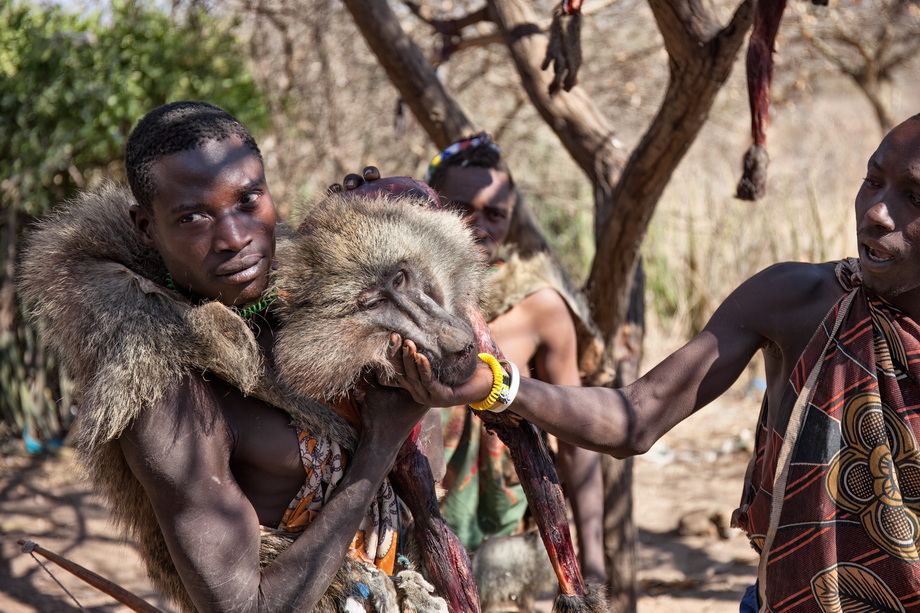
Those Hadza who live in bush camps and continue the foraging lifestyle are central-place foragers or “central place provisioners” (Marlowe 2006). They collect food daily, eating a substantial portion of what they acquire before returning to camp where they distribute the remaining food to weaned infants and dependent children, as well as to any elderly, injured, or disabled camp members who may be present. Food is widely shared both within and outside of the household (Marlowe 2004). The Hadza diet is diverse and well balanced, including a wide variety of plant foods (e.g. tubers, berries, fruits, legumes, nuts, and seeds), small- to large-sized game animals, a number of bird species, and the larvae and honeycomb of both stingless and stinging bees. The diet, which is seasonally variable, was estimated in bush camps in 2010 to be approximately 49% plant foods, 32% meat, 11% honey, and 8% traded foods (Crittenden 2016). Early estimates of diet composition differed slightly (see Marlowe 2010).
Women typically forage in groups and target plant foods, while men forage solo or in pairs and focus primarily on hunting animals and collecting honey. Those Hadza living a less traditional life supplement wild foods with traded, purchased, or donated foods. In 1995-1996, working in camps all over the Eyasi basin including camps near villages, Marlowe (2010) found that agricultural products, mostly received in trade for honey, comprised the same proportion of calories (5-6%) as O'Connell, Hawkes, and Blurton Jones (1991) found in the most remote camps in 1985-1986. As of 2019 the amount of agricultural products in the diet had increased significantly (Crittenden et al. 2017; Gibbons 2018). An increase in ethno-tourism has greatly increased the number of Hadza who live on the peripheries of villages and make a living by taking tourists on short, daily hunting and gathering treks, and performing Hadza songs and dances (Yatsuka 2015). A few other Hadza may work as guides for hunting safari companies, as paid guards for farms of neighboring tribes, or as seasonal employees of ethno-tourism companies, researchers, missionaries, and non-governmental aid organizations (NGOs). Foods are obtained via trading, as payment from tourist groups visiting the Hadza, or as donations from missionaries or NGOs. The destructive influence of alcohol is most evident among those living in more settled areas (Butovskaya 2013), although alcohol traders have found their way to camps deep in the bush.

Up through the 1990s, the Hadza refused to take money, as they had no way to use it. Acceptance has gradually increased as goods have become more accessible, and by 2019 many Hadza were using Tanzanian currency in the villages. Since at least 1910, the Hadza exchanged honey and skins with their neighbors for knives, pots and beads. Their long-standing trade of honey with neighbors, especially Datoga pastoralists, was evident in the 1980s and 1990s. While most outside attempts to encourage the Hadza to become commercial honey traders have failed, in 2017 there was a government mandate to start providing fixed comb beehives annually to Hadza communities living in one region of their territory. As of 2019, tourism has become the major commercial activity (Yatsuka 2015).
Hadza women use pounding stones or hammerstones, called ha’ako, to process baobab fruit and marula seeds (Benito-Calvo et al. 2018); they do not modify these stones, instead selecting them carefully for appropriate size and shape. They occasionally weave baskets out of plant fibers, but since the 1980s aluminum pots have been widely used as containers; by 2010, plastic buckets were also commonly in use. Plant fiber and animal tendon are used for stringing beads and headbands. Homemade leather sandals, still worn by a few people until the late 1990s, have been replaced by the rubber sandals made out of recycled tires that are available all over Tanzania.
Equipment in daily use remains essentially the same as that illustrated over the past century by Reche (1914), Woodburn (1970), and Marlowe (2010). Digging sticks, and bows and arrows—which are used, respectively, by women and children to dig for tubers, and by men and boys for hunting—are either made out of the wood of mutateko (Dombeya kirkii), kongoloko (Grewia bicolor), or ts’apaleko (Cordia sp.) (Peterson et al. 2013). Arrow shafts are straightened by heating the wood over the ashes of a fire and then using the mouth as a clamp to bend the shaft (Woodburn 1970). Arrows are then fletched with the feathers of guinea fowl or vulture and bound with animal sinew.5 After the turn of the twenty-first century the Hadza began using twine, when available, in the place of animal sinew for stringing bows. For large game hunting, arrows are tipped with one of two types of plant poison, shanjo (Strophanthus eminii) or panjube (Adenium obesum) (Bartram 1997); a third type of poison, kalakasy, is made by neighboring tribes and is occasionally obtained through trade.
Axes are valuable tools that men use to access honey, a significant component of their diet (Crittenden 2011; Marlowe et al. 2014; Wood et al. 2014) and a highly preferred food item (Berbesque and Marlowe 2009). Axe handles are made from gobandako (Terminalia brownei) or mnupeko (Lonchocarpus eriocalyx), whereas the metal axe heads are obtained through trade (Peterson et al. 2013). Fire drills—long narrow sticks used to create fire by inserting the tip into a smaller piece of wood and “drilling” to create friction—are either made out of Commiphora schimperi or Markhamia obtusifolia (Peterson et al. 2013). Up through 1990, men’s gambling discs (used for games of chance) were made out of the bark of the baobab tree (Adansonia digitata) (Woodburn 1970). In 1990, men at a very brief government settlement project called Mongo wa Mono were seen gambling with shoes. By 2016, Tanzanian coins had become the standard for almost all games played by adults, and recycled soda tops the standard for most variants played by juvenile boys.

Items obtained by trade since the early twentieth century (Obst 1912) include beads, knives, axes, and iron to make arrow heads in exchange for honey, skins and, sometimes, meat. Archaeology shows iron in the Eyasi basin since AD 200 (Mabulla 2007), and long distance trade of obsidian from 130,000 BP. Trade in meat by the Hadza has remained remarkably rare.
The purchase of maize, sugar, salt, tea, clothing, and household items such as knives, cooking pots, radios, blankets, clothing, and mosquito nets has steadily increased since national economic changes in 1986. The use of these items has become ubiquitous since the turn of the twenty-first century, with the continuing growth in ethno-tourism, and an increased number and more common presence of researchers, missionaries, and non-governmental organizations.
In 2010 the Hadza began engaging in a different type of trade. In collaboration with Carbon Tanzania (a carbon project developer) and Dorobo (a Tanzanian non-governmental organization), the Hadza began receiving payment through the sale of carbon offsets generated by protecting their land. In 2014 it was estimated that approximately 270,000 tons of carbon dioxide emissions will be prevented over the following twenty years based on the arrangement the Hadza have with these organizations (Nelson 2014).
Significant sex differences exist in both diet and foraging behavior. Men consume a greater amount of meat, whereas women consume a greater proportion of plant foods (Berbesque et al. 2011; Schnorr et al. 2014). This maps onto foods targeted, as women typically forage in groups and target plant foods, while men tend to hunt solo or in pairs and focus on game animals and collecting honey; all eat while foraging as well as at home (Berbesque et al. 2016). In the 1980s and 1990s, hunting and food sharing data collected among the Hadza showed that the meat of large prey was an unreliable food source shared widely outside of the household, leaving many meatless days. Small game animals were often ignored, but men who were incentivized by researchers to concentrate only on small game were able to acquire enough to feed their family almost daily (Hawkes et al. 1991; Hawkes et al. 2001). These data were used to support the “show-off hypothesis” which suggests that success at hunting large game signals qualities of the hunter to both potential mates and potential rivals, even though a more effective provisioning or parenting strategy would be to concentrate on small game and honey (Hawkes et al. 1991; Hawkes et al. 2001). In contrast, food sharing data collected in the 2000s suggested that Hadza fathers do indeed successfully provision their households by focusing on both small and large prey, indicating that hunting may represent an investment in both mating and parenting (Wood 2006; Wood and Marlowe 2013, 2014; Hawkes et al. 2014). The debate over the “show-off hypothesis” continues (Stibbard-Hawkes et al. 2018).
One of the most well-known attributes of Hadza foraging is the high productivity of post-menopausal women (grandmothers). The so-called “grandmother hypothesis,” originally based on data from the Hadza, proposes that post-menopausal women increase their lifetime reproductive success by ceasing direct investment in reproducing additional offspring and focusing significant investment in their grandchildren (Hawkes et al. 1997, 1998).
The Hadza have not clearly demonstrated any tendency to exclude each other from any part of their ancestral land. They have frequently spoken to anthropologists of their wish to exclude non-Hadza from the land that they have occupied for so long, but they recognize their numerical disadvantage. In order for a hunting and gathering subsistence regime to continue, foragers require land and the resources that it houses. The population of Tanzania continues to increase at three percent annually, and for several decades the area occupied by the Hadza has been in great demand from neighboring tribes and outside parties (Madsen 2000). In 1985 the eastern Hadza occupied an area of about 2500 km². In the mid-2000s, a safari company secured access to the land in order to provide private hunting grounds for clients from the United Arab Emirates. Due to pressure from several human rights organizations, the company withdrew from the area (Survival International 2007). In 2011, Hadza living in the Yaeda Valley region of Northern Tanzania were issued land titles for an area encompassing approximately 20,000 hectares (one-twentieth of their pre-1964 terrain), obtained with assistance from local non-profit organizations (the Ujama Resource Community Team and the Dorobo Fund), The Nature Conservancy, and the Tanzanian Ministry of Lands (Survival International 2011). As of 2019, although the land is legally titled to the Hadza, it continued to be utilized by pastoral tribes in the area.
It has been suggested that the Hadza practice multilocality: they can be uxorilocal, virilocal, bilocal, or neolocal (Marlowe 2010). They practice bilateral descent through their mother and father and do not recognize clans (Woodburn 1968 “Stability and flexibility…”). Residence patterns are variable, despite a slight bias toward living in the same camp as the wife’s mother (Marlowe 2004). Residence data collected between 2000 and 2010 suggests that a large percentage of residents in any given camp may be genetically unrelated to one another (Hill et al. 2011) and that the Hadza have strong cooperative ties with both kin and non-kin (Apicella et al. 2012).
Kinship terms are broad and incorporate both classificatory and fictive kin. They have been studied by Woodburn (1964), Marlowe (2010), and Miller (2016); no complete consensus has been reached.
Hadza marriage has been characterized as "serial monogamy" (Marlowe 2010); divorce and remarriage are common, polygyny is rare. Ceremony is minimal. Hadza recognize couples as a union between a man and a woman who also reside in the same hut. As Woodburn (1968 “Stability and flexibility…”) initially reported, during the day husbands and wives are apart for much of the time, even when both are in camp. In the evening in their hut, there is an atmosphere of friendship and intimacy between them. Marriages studied between 1985 and 2000 had a half-life of seven years, but some had lasted as long as forty years. Peak probability of dissolution was at four years (Blurton Jones 2016), as in other populations (Fisher 1989). The crude divorce rate is high: in the late 1960s it was reported as 49 per thousand years of marriage (Woodburn 1968 “Stability and flexibility…”), and for marriages between 1985 and 2000 it was reported as 64 per thousand (Blurton Jones 2016). Some divorces follow infidelity, violence, or the death of a child. Spousal abuse is not routinely accepted among the Hadza as it is among some of their neighbors (Butovskaya 2013), and is given by some Hadza women as the reason they left a husband of another tribe. Some men (especially those recognized as expert hunters by other Hadza) divorce in mid-life and remarry a much younger woman; in doing so they almost double their reproductive success. Occasionally a man or, less often, a woman has been able to remain married to two spouses for short periods of time (approximately a year or two).
Children primarily reside with their parents and siblings, but may live with grandparents or aunts and uncles. Children sleep in the same hut as their primary caregiver until they reach puberty, at which point they can sleep in a hut with their age mates (typically constructed close to that of their parents and/or grandparents) (Crittenden et al. 2018). Children are tended by a wide range of caregivers; while mothers provide the bulk of care to infants, allomothers (caregivers other than the mother) also provide significant amounts of care (Hawkes et al. 1989; Marlowe 2005). Additionally, there are strong effects of the absence of grandmothers on the survival of children under the age of five years (Blurton Jones 2016).
The Hadza have few possessions of lasting value. Woodburn (1982) describes a dead person's belongings as being shared among those present at the time of death.
The most recognized attribute of Hadza childhood is the productivity of young foragers. Children are active foragers, and data from Blurton Jones et al. (1989, 1997) suggest that by the age of seven to ten they were able to collect and process sufficient food to provide up to half of their estimated daily caloric requirement by working for approximately two hours. Children tend to focus on resources that are relatively easy to collect (e.g. berries, fruit, nuts, shallow tubers, and birds or other small game animals) and that can be found close to camp (Crittenden et al. 2013). Children forage alongside adults as well as autonomously in large, mixed age, mixed sex groups of children (Lew-Levy et al. 2019).
Very young boys tend to limit their hunting play to the borders of camp where they shoot small species of mice and birds with miniature bows and arrows, and occasionally trap small animals with a string noose. The very first bow is made of a small twig, and the accompanying arrows are made of grass and tipped with beeswax or plant resin to provide weight (Crittenden 2016). As they mature, the size and precision of boys’ bows and arrows also matures, and boys begin to travel longer distances from camp and to target somewhat larger animals such as hyrax and medium- to large-sized birds. For their part, girls mainly collect fruit and tubers, and are sometimes called upon to do greater amounts of childcare, water collection, and household maintenance than their male counterparts.
Some Hadza adults value formal education, while others maintain that children are better off learning the ways of a nomadic bush lifestyle. Three phases of school attendance are observable for the period between 1964 and 2016. In the 1960s, when most Hadza were forcefully settled in government camps at the locations of Yaeda and Munguli, many children attended primary school, and about ten were even sent away to secondary school. By 1985 only a handful were attending those schools. The second phase began in 1990, when government trucks came to take children from bush to school at Endamagha; few stayed more than two years, many only a few days. The children who remain in school after they are required to attend generally enjoy it, but many others choose to leave school, returning to the bush to live with their families. By 2010, approximately twenty percent of Hadza people under the age of fifty had at least some level of formal education, attending school for a minimum of a portion of one academic year; for Hadza people under the age of thirty it jumps to over fifty percent (Marlowe 2010). The third phase began around 2010, when government trucks again began coming to collect children from the bush and bring them to the village school in Endamagha.
Hadza childhood has often been categorized as relatively carefree. Nursing infants are breastfed on demand, and accompany their mothers on daily foraging trips until they are too heavy to be carried long distances or when the mother becomes pregnant with a subsequent child—typically at two years of age (Blurton Jones 2002). Infants are first introduced to supplemental foods around six months of age, although parents and other caregivers might provide small tastes of soft or liquid foods before that time (Ungar et al. 2017). They are weaned relatively suddenly when they are two to three years old, and are left in camp with older children.
Like almost all other hunter-gatherer groups, the Hadza have an egalitarian social structure. Although they recognize an affinity with other Hadza, they do not typically recognize land rights in the traditional sense. There is no political structure, formal or informal, at the tribal level (Woodburn 1968 “Stability and flexibility…”; Marlowe 2009). Camps have a fluid composition of extended families and friends, and labor and food are shared widely between related and unrelated camp members. Hadza women have a great amount of autonomy, and equal decision-making power with men (Apicella et al. 2016; Marlowe 2010). In the 1990s there was growing awareness among some individuals of government, and of its powers and the opportunities it might provide. Before that time, government was regarded as a capricious danger that was inclined to try to force one to settle and farm. By the turn of the twenty-first millennium and continuing through 2016, many Hadza were involved in efforts to obtain title to their land.

Woodburn (1968 “Stability and flexibility…”) reported that camps are sometimes referred to by the name of an older man living in the camp, but this signifies neither any particular role nor influence of the individual concerned. Some of these men were recognized by other Hadza as having preferred ranges of approximately thirty kilometers on a side, within which their camp was likely to be found.
During the day, men who are in camp are usually found gathered at some shady spot at the outskirts of camp, where they make arrows and discuss matters of importance. These include some rules of conduct, the infraction of which can require earnest discussion and undetermined interventions. It was reported in the 1960s and the 1980s that it was at this “men’s place” that they ate epeme meat (on which there are prohibitions). By the turn of the twenty first century, all epeme meat was consumed outside of camp, away from women and children. Women, too, tend to have places in camp where they gather. It also is usually in a shady spot, where they gather to bead, process baobab seeds, and talk about the happenings in camp. Children often play in central areas or in places near the gathered women.
Social control is best described as absent or weak. The autonomy of individuals—male, female, old, or young—is striking. There are a few contexts in which men collaborate to attempt some sort of control over each other or over women.6
Individual arguments can break out at any time, but are infrequent. Arguments between women can be very noisy; even those remaining aloof must be aware of the participants and some aspects of their complaints. Most arguments appear to dissipate without obvious consequence (Butovskaya 2013).
Few instances of obvious camp fission have been documented although, when a camp moves, members can end up at different locations. Families, or numbers of less closely related people, can join a camp with no explicit efforts to stop them; they simply arrive and build a house or clear a patch. Noisy breakups and divorces have been witnessed by several anthropologists, and there are many stories recounted of contentious separations not necessarily witnessed firsthand. Early ethnographers, such as Kohl-Larsen and Woodburn, witnessed breakups that included talk and threats of murder. More recently there have been breakups reported to anthropologists that include accounts of domestic violence and homicide against women.
The homicide rate is very low, 33-44 per 100,000 person-years (Blurton Jones 2016). Woodburn (1979) has pointed out the ease and anonymity with which a Hadza person could be murdered by another, and indeed, a small handful of such cases are known. Woodburn (1979) discusses this potential as part of the "leveling process" that others have described among hunter-gatherers. The homicide rate for the 2010s is unknown, but some anthropologists anticipate that it is significantly higher than reported by Woodburn (1979) and coincident with the increased rate of alcohol consumption seen in many Hadza camps by 2015.

Although the Hadza have repeatedly been approached by missionaries for many decades, they have no formal religion. They do have a cosmology that includes the sun, moon, stars, and their ancestors (Marlowe 2010; Woodburn 1964). They have a creation story that describes how the Hadza came to populate the earth, involving their descent to earth, either from a baobab tree or down the neck of a giraffe (Matthiessen and Porter 1972). Only a handful of serious studies on religious beliefs have been attempted. Field workers find that the Hadza can be very misleading informants, perhaps because they have experienced the scorn of neighboring tribes over such matters. Berger (1943) collected stories (published in German), and from 2013 – 2015 Apicella (2018) collected thoughts on creation stories. A Hadza, Gudo Bala (1998) collected stories from several informants and, helped by researchers Bonny Sands and Jeannette Hanby, wrote them down in Swahili and Hadzane. All stories and interpretations involve overlapping mythical and religious realms.
The Hadza do not have anything equivalent to religious leaders or churches. There are no shamans, or medicine men or women. One of the only specialist roles is that of the maitobe, the practitioner of the maiteko ritual, fulfilled by a well-respected senior woman (Marlowe 2010).
The strongest beliefs, prohibitions and rituals surround epeme (Marlowe 2010; Woodburn 1964) and maiteko; both are gender rituals. Epeme refers to an almost monthly ceremonial dance and also to certain cuts of animal meat that are attributed great significance; both epeme rituals are governed by “male held secrets.” Maiteko is a female initiation ritual, largely governed by “female held secrets” (Power 2015). Hadza informants have expressed great reluctance to allow the men's secrets of epeme to be released, or to discuss maiteko.
There are some rock paintings in Hadza country that resemble those found over a wider geographic area. Early ethnographic records (Bleek 1931) report that the Hadza claim no knowledge of them; however, later sources cite Hadza claims that the rock art was made by their ancestors (Mabulla 2007).
Until the turn of the twenty-first century, much Hadza jewelry (earrings, necklaces, bracelets, anklets, waistbands, and headbands) was made of organic components, including plant products (grasses, seeds, and reeds) and items such as small animal bones, bird feathers, pangolin scales, shells, and porcupine quills. Early ethnographies report Hadza receiving glass beads in trade from the neighboring Isanzu tribe (Obst 1912); given their importance as trade items in East Africa since AD 800, it would be surprising if the Hadza had not acquired beads through trade long before these first reports. Beads made from ostrich eggshell were also used up until the late twentieth century, similar to cross-hatched types found in archaeological sites in the Lake Eyasi Basin dating to 130,000 BP (Mabulla 2007). During the second half of the twentieth century and into the twenty-first, Hadza jewelry began incorporating major amounts of glass beads obtained by trade with neighboring tribes or as gifts from researchers and non-governmental organization workers. In the 1990s Hadza women also began to make beads from discarded plastic. Girls sometimes decorate themselves by smearing animal fat (also used as lotion) on their faces as an adhesive for colorful flower petals.
Government health clinics were built in all areas surrounding Hadza country in the 1960s. During interviews conducted in 1966-1967, 49 percent of Hadza interviewed had at some time attended a health facility (Bennett et al. 1973). In 1999, 41 percent of the women interviewed had attended a clinic at least once during their lifetime (Blurton Jones 2016). By the turn of the twenty-first century, visits to local hospitals were fairly common, and by 2018 traveling medical clinics began routinely servicing remote bush communities.
Many plant species are employed in medicine, as noted in the earliest reports on Hadza plant use. Most adults know what plant species to seek as treatments for particular ailments. The bark of mondoko (Entadrophragma caudatum) is peeled, boiled, and used as a compress. For chest congestion, the Hadza smoke the dry root shavings and leaves of pun//upun//u (Croton menyhartii) or make a tea by boiling the bark of morongodako (Zanthoxylum chalybeum) (Peterson et al. 2013). Other plants (species unknown) are used to treat sore throats, diarrhea, general aches and pains, fever, and snake bites (Marlowe 2010; Woodburn 1959). Beaded jewelry—earrings, necklaces, bracelets, anklets, waistbands, and headbands—often plays a dual role, functioning both as bodily adornment and ethnobotanical medicine. Both sexes may wear beaded items, except for the waistbands worn underneath their clothing by women alone. Older women, typically grandmothers, act as midwives and birth attendants.
Relatively little is known or well understood by researchers about Hadza beliefs concerning death, perhaps because the Hadza are not forthcoming due to the scorn they have experienced from their neighbors. Woodburn (1982) described events surrounding death based on his personal observation in the mid-late twentieth century. People mourn, distribute belongings, bury the body with preferences about its orientation, and move camp. The deceased is commemorated at an epeme dance some time later. There seemed to be no complex of ideas about an afterlife. Skaanes (2015), perhaps because she was assisted by a well-educated Hadza woman or perhaps because the Hadza were less concerned about the opinion of neighbors, found informants who spoke much more freely about death. A concept of a persisting spirit was evident, closely tied to the name of the individual, to the shadow, and to some of the "power objects" long recorded as part of Hadza material culture.

Sources: