

The Turkana are a Nilotic people native to the Turkana County in northwest Kenya, a semi-arid climate region bordering Lake Turkana in the east, Pokot, Rendille and Samburu people to the south, Uganda to the west, and South Sudan and Ethiopia to the north. They refer to their land as Turkan.
According to the 2019 Kenyan census, Turkana number 1,016,174, or 2.14% of the Kenyan population, making the Turkana the third largest Nilotic ethnic group in Kenya.
Although this figure was initially controversial and rejected as too large by Planning Minister Wycliffe Oparanya, a court ruling (Feb 7, 2012) by Justice Mohammed Warsame stated that the Kenyan government accepts the 2009 census figures for Turkana.

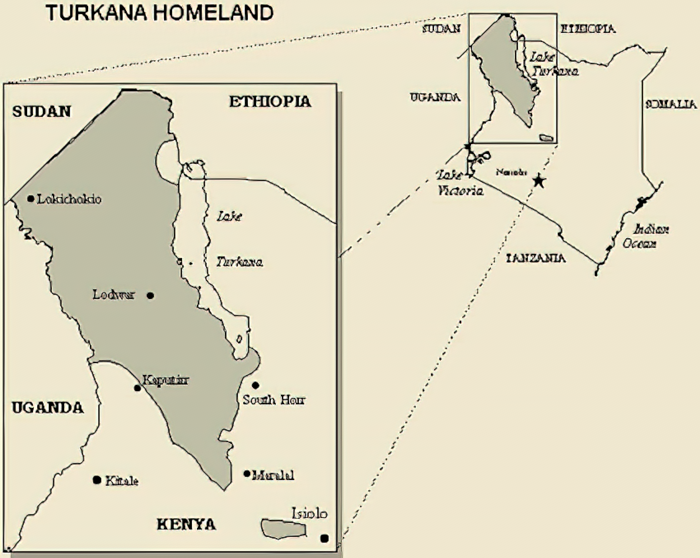
The language of the Turkana, an Eastern Nilotic language, is also called Turkana.
The Turkana people call themselves ŋiTurkana (The Turkana). The name means the people of Turkan. They are mainly semi-nomadic pastoralists.
The Turkana are noted for raising camels and weaving baskets. In their oral traditions, they designate themselves the people of the grey bull, after the Zebu, the domestication of which played an important role in their history. In recent years, development aid programs have aimed at introducing fishing among the Turkana (a taboo in some sections of The Turkana society) with very limited success.
The Turkana refer to themselves as "Ngiturkan" and their land as "Eturkan". The Turkana ethnic group as a whole is composed of two major divisions, each composed of territorial sections. The major divisions are: the Ngimonia, divided into Ngissir and non-Ngissir sections; and the Ngichoro, divided into Ngilukumong, Ngiwoyakwara, Ngigamatak, Ngibelai, and Ngibotok.

Turkana people speak Turkana. It is one of the Eastern Nilotic languages, and is closely related to Karamojong, Jie and Teso of Uganda, to Toposa spoken in the extreme southeast of Sudan, and to Nyangatom in the Sudan/Ethiopia Omo valley borderland; these languages together form the cluster of Teso–Turkana languages.
The Turkana people emerged as a distinct ethnic group sometime during the early to middle decades of the nineteenth century. Oral history and archaeological evidence suggest that, prior to A.D. 1500, the ancestors of the Ateker Language Group lived somewhere in the southern Sudan and most likely subsisted as hunting and gathering peoples. After beginning their southern migration, these ancestral peoples incorporated both agricultural and pastoral pursuits, and eventually split into groups that emphasized one subsistence strategy or the other.
The period from 1500 to 1800 appears to have been characterized by frequent splitting and fusing of ethnic groups, and shifting alliances among the groups. During this time, the Karamojong established a distinct identity with a subsistence system based on the raising of livestock, principally cattle, combined with small-scale agriculture.
Oral histories suggest that the Jie seceded from the Karamojong, and that a group split off from the Jie and established themselves in the region near the headwaters of the Tarach River, in what is now Turkana District, sometime during the early part of the eighteenth century. By the beginning of the nineteenth century, Turkana cattle camps began to push down the Tarach in search of new pastures upon which to graze their animals. As they moved westward, the Turkana encountered other pastoral groups, some of which herded camels (most likely the Rendille and Borana). As the Turkana expanded eastward, they began both to assimilate and disperse other groups. They first pushed to the north and east to Lake Turkana, and then to the south, crossing the Turkwell River. It appears that by 1850 the Turkana occupied much of the territory they use today.
The first European to enter into the land of the Turkana was Count Samuel Teleki von Szek, whose expedition reached Turkana in June of 1888. He was preceded by Swahili caravans in search of ivory, which first arrived in 1884. About the same time that the Swahili arrived in the south of Turkanaland, Ethiopian ivory hunters began arriving in the north. Within a few years, there ensued a period of conflict and contestation between the British and the Ethiopians over the colonial domination of the Turkana, which lasted until 1918.
The Turkana resisted British domination of their homeland throughout the early part of the twentieth century. Turkana raiding on their pastoral neighbors, especially against the Pokot to the south, caused large-scale social disruption and influenced the British decision to launch one of the largest military expeditions they ever mounted against an indigenous people. In 1918 a combined force of over 5,000 well-armed men, consisting of Sudanese troops, troops of the Kings African Rifles, and levies composed of warriors from groups antagonistic to the Turkana, launched what came to be known as the Labur Patrol.
The Labur Patrol broke the military might of the Turkana; in 1926 civil administration was reintroduced, and in 1928 taxes were reinstated. The period from 1929 until World War II appears to have been peaceful. Beginning in the 1950s, the Turkana again began to resist British domination, and the British launched a series of military expeditions against the Turkana. The use of occasional military forays against the Turkana was continued by the Kenyan government following independence in 1963.
Development in Turkana District was slow. Only two primary schools operated in the district at the time of independence. During the 1970s major efforts were made to help the Turkana integrate into the larger Kenyan economy; however, antagonistic relations among the Turkana and their neighbors continued, and by the early 1980s the entire district was considered highly insecure. Insecurity combined with two severe droughts in the early 1980s to inhibit development efforts. Despite the growth of settlements, the area remains remote, insecure, and relatively underdeveloped.
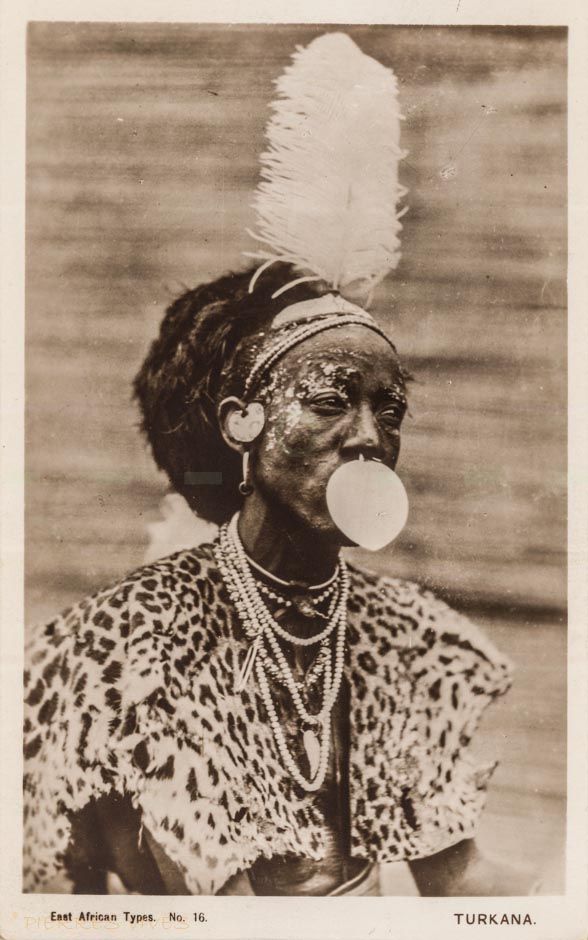
Strangely enough, the Turkana have abandoned very many customs (tribal rites), which are classical of the nomadic Maasai peoples e.g. they discarded both male and female circumcision.
However, when they infiltrate other tribal zones, they readily accept to return to it, as a sort of adaptation to the new habitat. Instead of circumcision’s initiation they practice the so called initiation of ATHAPAN, for men only.
Though they live a nomadic life Maasai style and base their subsistence on meat, blood, milk and butter, these have no particular sacred significance as they have for the Maasai. Just in the same way the age-set classification is not strictly followed and has given way to a bland system of alternation.

Houses are constructed over a wooden framework of domed saplings on which fronds of the Doum Palm tree Hyphaene thebaica, hides or skins, are thatched and lashed on. The house is large enough to house a family of six. Usually during the wet season they are elongated and covered with cowdung. Animals are kept in a brush wood pen. Due to changes in the climatic conditions most Turkana have started changing from the traditional method of herding cattle to agro-pastoralism.
The Turkana are one of the most mobile populations in the world. Traditionally, there were no permanent settlements occupied by them. Small settlements were built during the colonial period, but very few Turkana were attracted to them. Following the droughts of the 1980s, approximately one-half of the Turkana population settled in, or adjacent to, large famine-relief camps. Today it is estimated that about one-third to one-half of the Turkana population remains settled. The fastest-growing settlements are the district capital, Lodwar, and the villages located along the Turkwell River that depend upon irrigated agriculture.

To make up for this they have developed a considerable taste for craftwork, demonstrating an ability far above that of any neighbouring tribes.
Rightly famous, their blacksmiths manage to extract iron from a certain kind of rock, to make spears and tools. Not to mention all objects they get out of timber, leather, metal, seeds, bones, ivory, horns, hooves and nails, feathers etc.
This inclination for craftwork has pushed the Turkana a few steps ahead of the neighbouring tribes on the road to industrial civilisation which is making inroads even in the semidesert nomad's districts.
Strangely enough however, there is no textile craft... maybe for lack of animal and vegetable fibres. Patient leatherwork is a useful pastime especially for women who, in zones untouched by european civilization, are still dressed in skins.
Very interesting are the leather skirts adorned with strings of multicoloured beads.
Turkana men love to decorate their hair with feathers (of ostrich, generally) which they keep in a big long zebu horn. When they become bold, they substitute their hair with a skin cap obtained from a cow's udder, and usually painted blue, into which they stick ostrich feathers when feasts or dances occur.
Other uses the breast skin of the ostrich itself. The Turkana's weapons are the classical ones of the nomads: spears, shield, bow and arrows, arm ring, bludgeon.
Only the youngster, who has been initiated into the tribe as a "man", can be given the true spear (after the Athapan).
Before that, the boy is only allowed to carry a piece of iron somewhat shaped like a spear, to defend himself from hyenas.
The classical shield, now rarely seen, is made from the hide of a hippo, rhino, elephant or buffalo. It is a strip just over 20 cent, in width and over one metre long. The shield for a Turkana has a function of deviating weapons rather than protect by covering the body (as is the case with the Maasai).
The well known arm-ring is a really dangerous weapon. Inserted on the wrist and covered with a thin strip of leather, it may look like an ornament, but once it is ready for use, it is better to be far away from it.
Characteristic only of the Turkana (today other tribes attempt to copy it) is the "fighting staff". It looks like a decorated stick but the decorations do leave their mark!

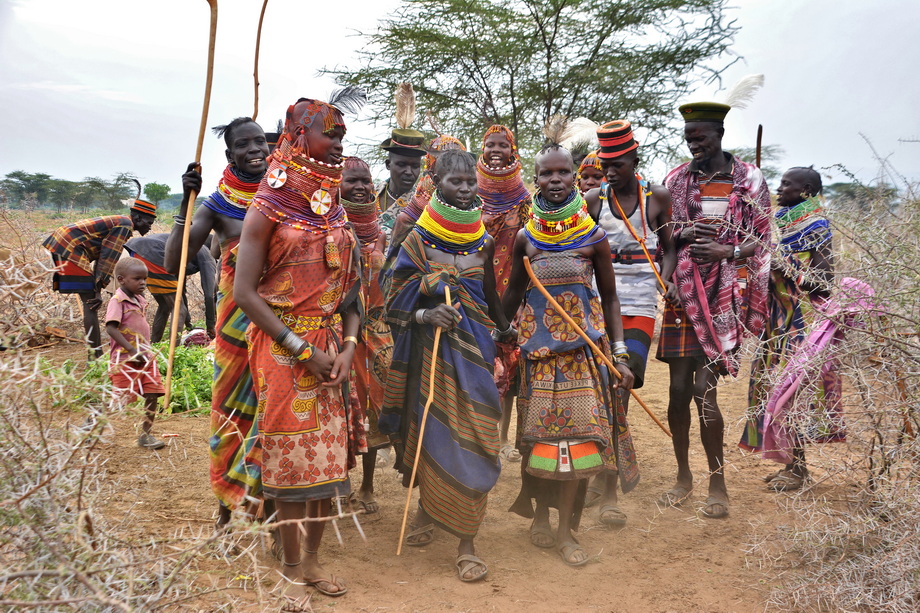
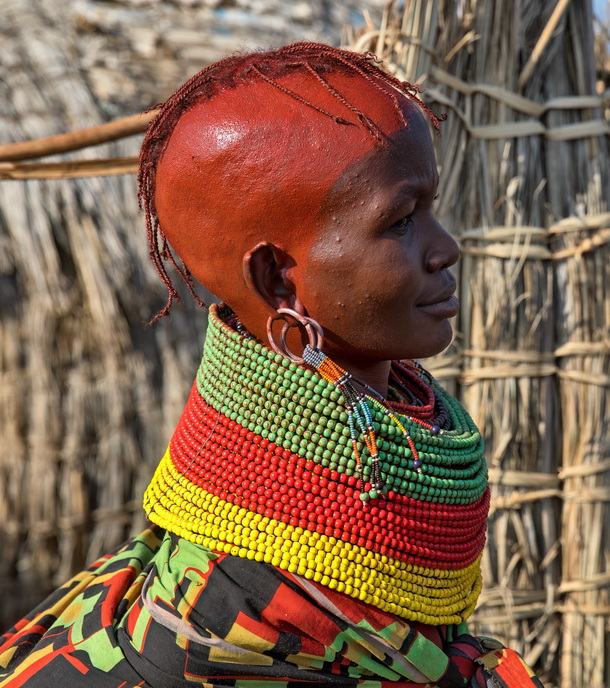
The subject of women's ornaments (and also of men's) is a catalogue of inventiveness, taste, suggestive meanings and many other things. Just by looking at a woman's ornaments, anyone conversant with Turkana customs may be able to know entire chapters of her life.
Even apart from ornaments which tell the difference between married and unmarried women, there are others indicating a great variety of events in the family: births or deaths, husband's long absence, sons to be initiated consecration to God etc...
Just as the mother has a taste for adorning herself, so she has a taste for decorating her small children who may have no clothing whatever, but will not miss a little necklace, button, a shell, a bracelet and a smart delicate belt of tiny shells around the waist.
The girl still to be married presents herself in society with a fine and rather curious triangular apron made of skin and embellished with bits of ostrich egg-shell.
The way of dressing up their hair among the Turkana (especially women) may help to distinguish a Turkana from a Samburu or a Maasai.
The married women and the girls (except in particular occasions such as mourning etc.) usually have a bunch of hair made up in a tress along the centre of the scalp.
Sometimes hair is twisted into a string, and, of course, greased with butter or fat.


Tattooing is practiced moderately mostly on the chest or on the belly. Sometimes it may be confused with the scars left by the witchdoctor's knife when, for lack of better medicines, he tries to let out the evil spirits by incisions.
The perforation of earlobes is instead a regular feature. Also the lower lip is often perforated to insert a trinket later on.
Kin Groups and Descent. One of the fundamental units in Turkana social organization is the exogamous patrilineal clan ( ateker or amachar ). There are twenty-eight clans among the Turkana, and, in general, they crosscut the sectional boundaries; some of the smaller clans, however, are quite localized. Each clan is associated with a particular brand for its livestock, and an individual can identify a relative in a new location in this way. Clan members call upon each other for help in times of need, but clan membership implies more of an opportunity for an individual to seek assistance than an obligation on the part of the person from whom it is requested.
Kinship Terminology. Kinship terminology is classificatory, but does not form a uniform system with respect to clan members. Terms such as those for "mother," "father," "brother," and "sister" are sometimes extended to clan members, but, to a large extent, this usage is based on the strength of individual relationships.

Subsistence. The Turkana are primarily a pastoral people; they depend on five species of livestock for their subsistence. Camels, cattle, sheep, and goats provide most of their subsistence needs; donkeys are used to transport household goods during migrations. The Turkana who live along the major water courses also engage in small-scale agriculture, and one section of the Turkana, the Ngibocheros, live along the shore of Lake Turkana and depend on fishing and aquatic hunting, as well as herding for subsistence.
Trade. The Turkana remain one of the more isolated ethnic groups in Kenya, and trade is still small in scale. The Turkana sell livestock to buy grains and household needs. The Turkana traditionally traded livestock for iron with ethnic groups in the highlands of Uganda.
Division of Labor. Most aspects of the Turkana economy are strongly influenced by the needs of the livestock and by the migratory pattern. During the rainy season, when all people and animals are together, men are responsible for the daily herding operation, and women are responsible for watering and milking the livestock, feeding the family, and other domestic chores. During the dry season, the livestock are often separated into milking and nonmilking herds. The nonmilking herds are usually herded by young men, who may be separated from the rest of the family for six months or more. During this time, all work related to the livestock is performed by the men.
Land Tenure. The land-tenure system is similar to that of many pastoral peoples. Grazing resources are open to all members of a territorial section; water resources, however, may be open to all or owned. In general, water in rivers and streams when they are flowing, open pools, and shallow wells are not owned. Deep wells dug through sand, clay, or rock are owned by the individual who dug them, and can be used by close male relatives and friends. In northern Turkana, the rules governing access to grazing do not appear to be as strict as those found among the sections living in the south.
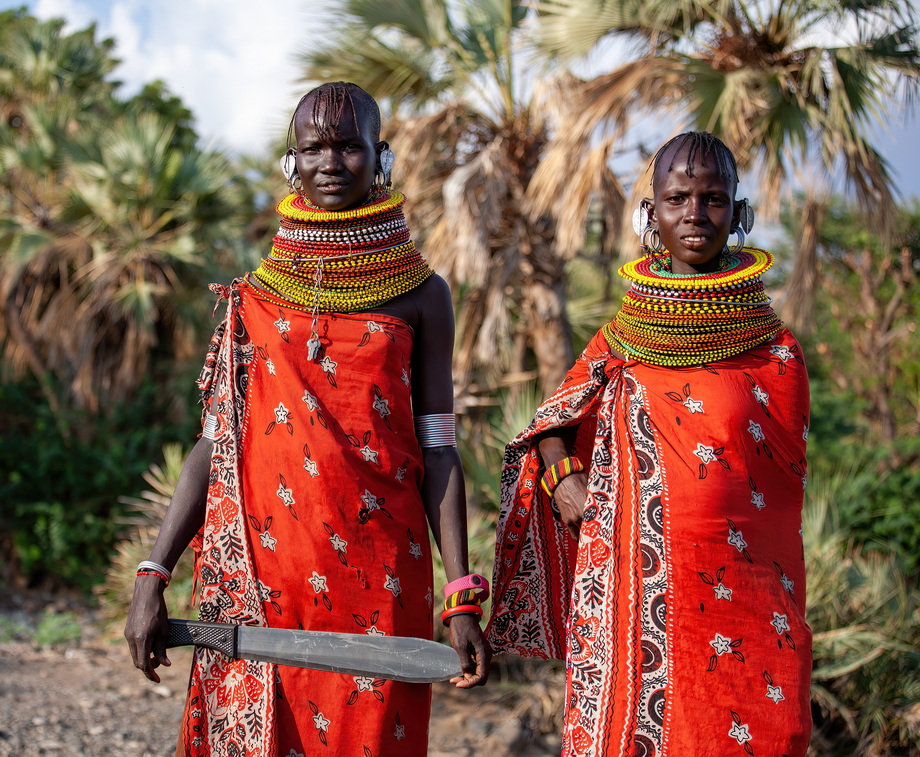
The Turkana rely on several rivers, such as the Turkwel River and Kerio River. When these rivers flood, new sediment and water extend onto the river plain that is cultivated after heavy rainstorms, which occur infrequently. When the rivers dry up, open-pit wells are dug in the riverbed; these are used for providing water to the livestock and also for human consumption. There are few, if any, developed wells for community and livestock drinking water, and often families must travel several hours searching for water for their livestock and themselves.
Livestock is an important aspect of Turkana culture. Goats, camels, donkeys and zebu are the primary herd stock utilized by the Turkana people. In this society, livestock functions not only as a milk and meat producer, but as form of currency used for bride-price negotiations and dowries. Often, a young man will be given a single goat with which to start a herd, and he will accumulate more via animal husbandry. In turn, once he has accumulated sufficient livestock, these animals will be used to negotiate for wives. It is not uncommon for Turkana men to lead polygynous lifestyles, since livestock wealth will determine the number of wives each can negotiate for and support.
Livestock also plays an important part in interactions between the Turkana and other neighboring groups, and is an important aspect of warfare in the region. Raids are not unusual in Turkana society and most of the time raids are conducted it is to steal cattle from neighboring groups such as the Taposa and the Pokot. In some cases, such raids have led to intense conflict in which dozens or even hundreds of people are injured or killed. In his book, Cattle bring us to our enemies: Turkana ecology, politics, and raiding in a disequilibrium system, J. Terrence McCabe cites several incidents in which raiding caused several deaths. McCabe notes that such raids often occur between the Turkana and the Pokot and that raiding seems to have increased in intensity over the last few years.

Marriage is also a very interesting topic and it follows a most interesting system. It begins with a real kidnapping (agreed to by the parties, but none the less with all the action of a kidnapping) and it is ratified — sometimes after several years — with a special ceremony in which a bull is killed and the bride (maybe already old!), is sprinkled with the dung of the animal.
Turkana marriage is polygynous and often patrilocal. Bride-wealth is unusually high among the Turkana; a typical bride-wealth payment might include 30 to 50 cattle, 30 to 50 camels, and 100 to 200 small stock. This high bride-wealth often means that a man cannot marry until his father has died and he has inherited livestock. The high bride-wealth also requires that the prospective groom collect livestock from all his relatives and friends, thus reinforcing social ties through the transfer of livestock.
A Turkana homestead ( awi ) is composed of a man, his wives and their children, and often his mother and other dependent women. Each wife and her children build a daytime sitting hut ( ekol ) and, in the rainy season, a nighttime sleeping hut ( aki ). When a new wife comes into the homestead, she stays in the ekol of the mother or first wife of the household head until she has borne her first child.
Wives are often inherited by a brother or the son of a co-wife upon the death of a husband. A woman has the right to refuse to be inherited and can live with one of her sons, if she chooses. As each wife comes into the household, the head of the family allocates milking livestock to her. Although she has no ownership rights to these livestock, they will form the basis of the herds that will be inherited by her sons. Most of a woman's livestock will be inherited by her firstborn son.

The Turkana, like many pastoral populations in East Africa, have no formal political hierarchy based on chiefs and subchiefs. Political influence is gained through age, wealth, wisdom, and oratorical skill. Turkana social organization can be seen as two systems of social relationships operating simultaneously. One system is based on territory and rights in pasture and water; the other is based on kinship, relationships among individuals, and rights in livestock and labor.
The basic unit of Turkana social organization is the awi. Most herd owners live and travel with two to five other herd owners and their families, forming what is referred to as an awi apolon, or large awi. The composition of this unit changes frequently, as individuals and families leave to join other homesteads, or others come to join the awi apolon. During the wet season, many homesteads congregate into temporary associations (sing, adakar ); these associations break up as resources become scarce with the progression of the dry season.
Above the awi, the next level of territorial organization is the section; above that, the tribe. Sectional membership confers upon the individual rights to grazing. It appears that in the past there were a number of ceremonial occasions in which tribal identity was reinforced. Today tribal identity is reified by rules of appropriate behavior concerning raiding and banditry among the sections.
Nonterritorial aspects of social organization are primarily related to clan and kinship relations. A critical feature of Turkana social organization, however, is the network of personal relationships, based on the exchange of livestock, which is built up by each herd owner over the course of his lifetime. It is to individuals in this network that a herd owner turns in times of need. From the perspective of an individual herd owner, most members of this association will be agnatic or affinal kinsmen, but there may also be many people in this network who are simply his friends.
Finally, each man is a member of alternating generation sets. If a man is a Leopard, his son will be a Stone; thus there are approximately equal numbers of Stones and Leopards at any one time. These groups will be formed when there is a need to organize large groups quickly. Some authors refer to a functioning age-set system, but almost all of the Turkana with whom McCabe worked had never heard of such a system, and a few others had only a vague recollection that an age-set system existed at some time in the past.
Conflict is usually resolved by the men living in proximity to one another. Men discuss such issues at "the tree of the men," and special attention is paid to men of influence. The decisions of the men will be enforced by the younger men of the area.

Turkana rely on their animals for milk, meat and blood. Wild fruits are gathered by women from the bushes and cooked for 12 hours. Slaughtered goats are roasted on a fire and only their entrails and skin removed. Roasting meat is a favorite way of consuming meat.
The Turkana often trade with the Pokots for maize and beans, Marakwet for Tobacco and Maasai for maize and vegetables. The Turkana buy tea from the towns and make milk tea. In the morning people eat maize porridge with milk, while for lunch and dinner they eat plain maize porridge with a stew. Zebu are only eaten during festivals while goat is consumed more frequently.
Fish is taboo for some of the Turkana clans (or brands, "ngimacharin"). Men often go hunting to catch dik dik, wildebeest, wild pig, antelope, marsh deer, hare and many more. After the hunt men go out again to gather honey which is the only sweet thing the Turkana have.
While the Turkana mainly rely on pastoralism they also cultivate some of their food. Multiple studies have made note of sorghum cultivation in Turkana society. One such study, Sorghum Gardens in South Turkana: Cultivation among a Nomadic Pastoral People, notes that while sorghum cultivation is quite productive it is more limited by environmental factors than pastoralism. The Jie, a long time ally of the Turkana, have sometimes been know to gift sorghum to the Turkana.
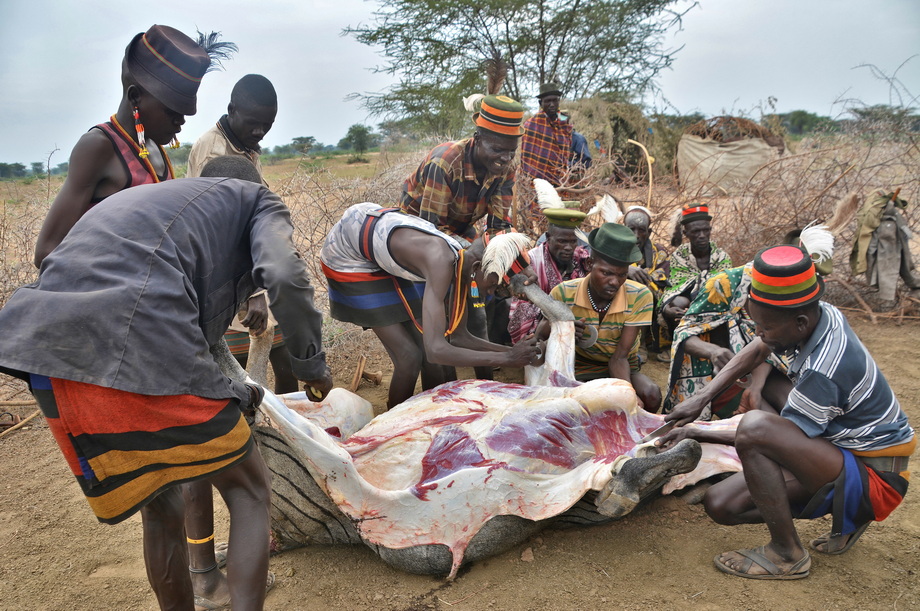

Traditionally, both men and women wear wraps made of rectangular woven materials and animal skins. Today, these cloths are normally purchased, having been manufactured in Nairobi or elsewhere in Kenya. Often, men wear their wraps similar to tunics, with one end connected with the other end over the right shoulder, and carry wrist knives made of steel and goat hide. Men also carry stools (known as ekicholong) and will use these for simple chairs rather than sitting on the hot midday sand. These stools also double as headrests, keeping one's head elevated from the sand, and protecting any ceremonial head decorations from being damaged. It is also not uncommon for men to carry several staves; one is used for walking and balance when carrying loads; the other, usually slimmer and longer, is used to prod livestock during herding activities. Women will customarily wear necklaces, and will shave their hair completely which often has beads attached to the loose ends of hair. Men wear their hair shaved. Women wear two pieces of cloth, one being wrapped around the waist while the other covers the top. Traditionally leather wraps covered with ostrich egg shell beads were the norm for women's undergarments, though these are now uncommon in many areas.
The Turkana people have elaborate clothing and adornment styles. Clothing is used to distinguish between age groups, development stages, occasions and status of individuals or groups in the Turkana community.
Today, many Turkana have adopted western-style clothing. This is especially prominent among both men and women who live in town centers throughout Turkana.

A clear boundary is not drawn between the sacred and the profane in Turkana society. In this regard, Turkana traditional religion is undifferentiated from Turkana social structure or epistemological reality—the religion and the culture are one. The Turkana are pastoralists whose lives are shaped by the extreme climate in which they live. Each day, one must seek to find the blessings of life—water, food, livestock, wives, children—in a manner that appeases the ancestral spirits and is in harmony with the peace within the community. Properly following the traditions (ngitalio) in daily life will certainly lead to blessing. Blessings are understood to be an increase in wealth, whether livestock, children, wives or even food. It is only through proper relationships with God (Akuj) and the ancestors, proper protection from evil, and participation in the moral economy of the community that one can be blessed.
Essentially, Turkana believe in the reality of a Supreme Being named Akuj. Not much is known about Akuj other than the fact that he alone created the world and is in control of the blessings of life. There is also a belief in the existence of ancestors, ngipean or ngikaram, yet these are seen to be malevolent, requiring animal sacrifices to be appeased when angry. When angered or troubled, the ancestors will possess people in the family in order to verbally communicate with their family. There is also the recognition of “The Ancestor”, Ekipe, who is seen as much more active in the everyday lives of people, yet only in negative ways. There is much concern over protecting one’s family and oneself from the evil of the Ekipe. Turkana Christians and missionaries equate ekipe with the biblical character of Devil or Satan and this has shifted more traditional understandings of ekipe away from “an evil spirit” to “The Evil one”. Turkana religious specialists, ngimurok, continue to act as intermediaries between living people and ancestors and also help in problem solving in communities.The Arabs also brought Islam to the people and hence the men wear the cap weather they are Muslims or not.
Ngimurok. As in most African traditional religions, traditional religious specialists in Turkana are present and play an active role in almost every community event. Ngimurok help to identify both the source of evil, sickness or other problems that present themselves, and the solution or specific cure or sacrifice that needs to take place in order to restore abundant life in the family and the community. There are various types of diviners differentiated by the emuron’s source of revelation. According to Barrett, the “true diviners,” also known as the “diviners of God”, are the most respected of the ngimurok because they receive revelations directly from Akuj, normally through dreams. These “true diviners” follow in the pattern of the most famous Turkana ngimurok, Lokerio and Lokorijem. The latter regularly received dreams from Akuj informing him of the location of the British Army during early 20th century colonial struggles, and the former is said to have used the power and knowledge of God to divide Lake Turkana so that warriors could walk across the lake to steal camels.
These ngimurok of God can still be found throughout Turkana, each in their own territory, alongside specialized ngimurok who have received specific abilities to read tea leaves, tobacco, intestines, shoes, stones and string. There are also hidden evil specialists, ngikasubak, who use objects in secret to work against people in the community, and ngikapilak, who specialize in pronouncing very strong curses employing the use of body parts from those recently deceased, but these are not included in the term emuron. Ngimurok are the people that Akuj and the Fathers speaks to in dreams; they are also the ones who can communicate with the ancestors to discern what sort of animal sacrifice is needed to restore peace, bring rain, find a remedy for a child’s illness, or who can properly bless the families at a wedding.
The ngimurok in each area receive direct revelations from Akuj, who is still directly active and concerned with the creation. These ngimurok do not speak or receive messages through an intermediary god or spirit through possession. While ancestor possessions are common in Turkana, they normally occur among younger people at the home, so that the ancestor can communicate their message to those in the home. The emuron would then be consulted as to what should be done. Ngimurok are not known as people who are normally possessed. Apart from the ngimurok, there are also important clan rituals in Turkana that represent the acknowledgement and transitions of life force. The most important rituals are the birth rituals (akidoun), male and female initiation rituals that do not include circumcision (asapan and akinyonyo), marriage rituals (Akuuta), annual blessing sacrifices (Apiaret an awi), and death rituals (Akinuuk). Each of these rituals is overseen by the elders of the clan, both men and women. The elders also oversee the community-wide wedding rituals, but an emuron normally plays a role in blessing the marriage.

The Turkana social structure is looser than that of their neighbours the Maasai, Samburu and Gabra. There are male elders rather than formal political leaders and individuals belong to one of twenty-eight patrilineal clans, each with its own ways of marking the transition from childhood to adulthood.
The Turkana are one of the few groups in this part of the world who do not practise circumcision; as Juxon Barton observed, in this and in many other cultural customs, they have more in common with the Karamojong and Dodoth people of Uganda to the West. For boys, rites of passage generally involve learning how to hunt and for girls the most important transition is marriage, a contract they can enter into as young as fifteen. One anthropologist, Itaru Ohta, who has conducted fieldwork among the Turkana since the 1970s, reported that when he once “gave papers and pencils to Turkana children to draw what they wanted, most of the girls made pictures of the front aprons of married women, which are different from those of unmarried women”.
Marriage is the most important determining factor in Turkana social organisation, as clan members are not allowed to marry others from their own clan or their mother’s birth clan.
Marriage is also important because it reinforces social alliances and creates clan support networks. Polygamy is encouraged so that a Turkana man may create a large working unit. A group of women interviewed on camera by anthropologists Judith and David MacDougall in the 1970s concurred, saying:
“A man should marry as often as possible, to feed and herd his animals…
He should have at least two wives. One wife is a misfortune, like a man with
one leg.”
For a Turkana man, marriage also marks the first step in becoming an independent livestock owner. This is because, as in neighbouring cultures like the Samburu, the groom must supply the family of the bride with ‘bridewealth’ – a payment in cattle (possibly up to one hundred) or even highly prized camels.
In the Turkana system of livestock ownership, all livestock is allocated to a woman’s ‘hut’, a space where married women set up huts once they have had a child. Prior to marriage, a man’s livestock technically still belongs to his mother’s hut and he will have to share any milk or meat with his siblings. Once married, that livestock transfers to his new family. It can sometimes take a man years to acquire enough livestock to satisfy the bridewealth, which explains why many men do not marry until their thirties and are often much older than their wife. Each wife means another bridewealth payment so it is unusual for a man to be able to afford more than two or three wives.
Arranged marriages (akota) are not unknown, but a male suitor will normally approach the girl’s kin to gain consent for their marriage. This might entail several visits and group discussions between the two parties and their parents, siblings and friends. Kinsmen of the woman, especially her parents, may take advantage of this opportunity to ask the suitor for numerous gifts, starting with small items such as tobacco, sugar, tea leaves and gourds, then requesting more substantial gifts such as clothes, blankets, cooking pans, goats or rams. Once it is agreed at these informal meetings that the union will go ahead, a formal, public round of negotiations about the bridewealth begins. This process, known as eloto, can be quite lengthy.


Despite their independence, their bravery and their freedom of movement, the Turkana are unable to control the single most vital element for ensuring their continuing prosperity: rain.
Rainfall is erratic, although usually sufficient to provide enough fresh grazing for the animals. But every few years (on average every ten), a natural cycle which may be connected to the El Niño effect causes a devastating drought, and with it the decimation of herds and the deaths of many people. Contrary to what many people believe, these droughts are not a cruel anomaly of nature (or global warming), but a naturally recurring if unpredictable event which the Turkana must survive. Yet the unpredictable nature of these events, as well as the terrible toll they take, have inevitably led them to explain this - and rainfall in general - as the work of a force beyond their control. This force is God, whom the Turkana call Akuj.
The vast majority of the Turkana still follow their traditional religion, which on the surface seems straightforward enough. There's one supreme God - Akuj - who is associated with the sky, and who can be addressed through prayer or through intermediaries such as diviners and living-dead ancestors. Like most people living in dry lands, the Turkana associate God with the provision or non-provision of rain. If God is happy, he will give rain. But if he is angry with the people, he will withhold it.
His plans can be 'read' by "dreamers", and he can be called upon in times of need or during important ritual life-stages such as birth, the confirmation of marriage, and in death. At other times, little concern is given to his existence, as indeed the Turkana believe that God pays little heed to them, and this to such an extent that he sometimes needs to be reminded of their existence.
Akuj resides in the sky, or else is the sky itself. He also lives near the tops of mountains, particularly those responsible for rain. Akuj, however, is neither thunder nor lightning, for the Turkana know that there can be lightning without rain, but there cannot be rain without Akuj.
The word Akuj (Akuji, or Kuj) itself derives from the same root as the words for 'up' or 'above' (nakuj means sky or heavens). As the provider of rain, Akuj is thus a benevolent force, although he is both the giver and taker of life. The Turkana have no God-centred creation myth as such, but Akuj's role as rain giver, and thus life-giver, is commonly misconstrued by some ethnologists to mean that he is also the Creator.
For the Turkana, the 'above' is a world divided between Akuj (God) or Akuj Nameri (God of the Stars) and Nipen or Ngiapan (spirits). Animal sacrifices are made both to Akuj and the spirits, so as to placate them at times of drought, famine, flooding, animal epidemics or any other disaster beyond human control.

With such an unpredictable God as Akuj, it pays to be forewarned. This is the work of various diviners and prophets known collectively as emuron, who are able to interpret or predict Akuj's plans through their dreams, or through other means such as the reading of a sacrificed animal's intestines, tobacco, "string", gourds and stones, and most famously through the tossing of sandals, whose configuration when fallen back to earth can be interpreted (akiteyen; "caused to know") as a sign. Most are men (ngimurok), although there are some women, too (ngamurok). The emuron are God's chief representatives, purifiers of age-sets, predictors of the outcome of raids or war, and rainmakers. There role is not only one of prediction, but also to find the causes and cures of disease, and thus they also function as doctors. When people have troubles, they approach the appropriate emuron, who will divine the proper course of action to take. Often, a diviner will have a certain limited area of responsibilities defined by the extent of their powers. In a case where other skills are needed, they will work together towards the common end.
In all cases, it is the emuron's role to relate what Akuj wants to communicate with the Turkana.

The most powerful form of emuron is the ekerujan or "dreamer", who has the closest union with Akuj, for it is in dreams that Akuj speaks most clearly to humans.
The role of emuron cannot be learned; neither is it hereditary, although a successful emuron is more likely to have children with the same powers as him- or herself. Instead, the state of prophethood is literally a calling, one chosen by Akuj. Before Akuj begins to communicate, he leads the unwitting candidate away from his home by the means of good spirits (ngipian lu ajokak). The prophet is taken to a place with much grass and animals, after which he is returned home. The person, probably rather shocked by what has happened, will relate the experience to other people, who then take him to an established emuron, who assures them that the man has been "taken away" by Akuj. The man is then purified (amook), and returns to normal life. It may be that that's the end of it all, and nothing further happens. But more usual is that the man begins to dream in a way different from before: he can "see" his dreams clearly, he begins to "speak out" (alimor) his "dreams" (ngakirujaeta), and they come true. This is because his having been "taken away" took him close to Akuj. He is now an emuron
.
Self-evidently, the dreamers can only be as accurate as Akuj or the extent of their powers allow them to be. In any event, they are powerless to prevent God from acting out his schemes or from forgetting to bring rain. Theirs is only a transmissive role.
So, come a disaster such as the failure of the rains, it is commonly believed that God is angry with the people, or that he has simply forgotten them. Indeed, some sources state that Akuj prefers cattle to people, and that people are really no more than a side-show. Whatever, the people now need either to placate Akuj, or remind him of their existence, and this is achieved through the propitiatory sacrifice of animals to influence Akuj, presided over by a special emuron.
The sacrifice itself is relatively uncomplicated. The animal to be sacrificed is presented to Akuj with a simple and direct formula, something like "This is your animal, take it" or "This is your ox, take him." The sacrificers then continue with an equally blunt demand: "Give us life, health, animals, grass, rain and all good things". As Akuj owns all the world's cattle, the sacrifice could be seen as the spirit of the sacrificed animal being recombined with Akuj.
Animal sacrifices are also made at important social events such as birth, initiation, marriage and death, where God is made happy through a sacrifice, and presumably won't make anything bad in relation to the event sanctified. Sacrifices are sometimes also called for to cure a person of a disease. The sacrificial animal for this has to be the same gender as the person who wishes to be cured, although the emuron can decide otherwise if he dreamt about the case.
Prophecy, sacrifice, the sacred and Akuj are intricately connected. Without prophecy, there would be no reason for sacrifice; without the sacred, the sacrifice would have no sense; and without God, the sacrifice would be done for nought.
Sacrifices can be seen as attempts by humans to bridge broken relations with Akuj. Through sacrifice, Akuj is "made cool" (akitillimilim) and "happy" (akitalakar) through the sweet-smelling odour of the roasted meat and the live-giving principle (eta) which has been released. Incidentally, the principle of 'coolness' is not surprisingly a sacred one, with many connotations. This is especially evident in the respect which is accorded to trees by cause of the shade that they provide. Shade, as well as rain to which the Turkana word is related, is seen as a blessing. And in the shade of a tree, elders traditionally gather to make decisions, to offer sacrifices, or arrange raids. In this same shade, too, is where meat-feasts eaten, warriors decorated, men initiated, marriages arranged and finalised, judgement made, Akuj implored; spears, wrist-knives and fighting sticks are also made in a tree's shade.

The death of a family head is very important because it raises the problem of settling the inheritance. Death of a family head or older person is accompanied by intense mourning. The body is disposed of by burial and often a meat feast will follow.
The cult of the dead is only given to the father and mother and important people such as emuron. These only have a right to be buried in the ground on which their hut is built. The hut will then be pulled down or abandoned. The eldest son inserts a piece of butter in the mouth of the dead person pronouncing this formula: "sleep in the cool earth and do not be angry with us, who remain on this earth." Other people traditionally were not given a burial, but were abandoned to hyenas and vultures. Nowadays, however, the Turkana are obliged to bury all their dead by law, although this is only verifiable in permanent settlements and in places where Christian missionaries have influence.
As is a common belief throughout Africa, the Turkana believe that upon death, the souls of the deceased go to the sky or else near to God. This does not, however, cut them off from their human relatives, who continue to hold that the living-dead are near to them and can be approached through prayer, libation and offerings. Thus the living-dead act as intermediaries between men and God, or between men and important, but more distant, forefathers. The "good" ancestors (ngikaram) can influence Akuj on their people's behalf through the medium of an emuron and the elders. However, the "good" ancestors can also be temperamental: diseases are often said to have been caused by them in anger at having been forgotten, much like Akuj 'forgets' the rain if the people have forgotten him.
In order to cure a disease, then, the patient can only be cured if the relationship with the ancestors is also cured, through prayers for unity that accompany an animal sacrifice, where pieces of meat are thrown towards the former dwelling places of ancestors, such as mountains, hills and rivers.


Sources: